
Hardscaping is everything in a yard that is built rather than grown: patios, pavers, driveways, walkways and steps, retaining and seat walls, patio covers and pergolas, outdoor kitchens and fire features. Softscape is the living part — lawn, plants, trees, soil and mulch — and “landscape” is the whole yard, both halves together. In a Southern California backyard the hardscape is where most of the budget goes. On our published Los Angeles cost guides, a poured concrete patio runs $8–$18 per square foot, a paver patio $15–$25+ per square foot, a retaining wall $30–$95 per square foot of wall face, an outdoor kitchen from $6,000 for a grill island, and a complete backyard remodel usually lands between $13,000 and $70,000.
We are Green Design and Build, a licensed residential general contractor based in Van Nuys (CSLB #1110975), building patios, paving, walls, covers and outdoor kitchens across Los Angeles, Orange and Ventura counties and the western parts of Riverside and San Bernardino counties. Every price on this page is copied from one of our individual cost guides, each linked below. They are budgeting ranges, not a quote — the number for your yard comes from a site visit.
Hardscape vs. softscape vs. landscape
Hardscape is the constructed, non-living surfaces and structures. Softscape is the living material and the soil it grows in. Landscape is the umbrella term for the whole outdoor space — and a “landscaper” in everyday speech is usually someone who plants and maintains, not someone who pours concrete or builds walls.
| Hardscape | Softscape | |
|---|---|---|
| What it is | Built, non-living elements: patios, pavers, driveways, walls, covers, pergolas, outdoor kitchens, fire pits | Living plants and their soil: lawn, shrubs, trees, ground cover, beds, mulch |
| Changes over time | Should stay put for decades if the base and drainage are right | Grows, spreads, dies back, needs replacing |
| Water | Sheds water — every square foot has to drain somewhere | Absorbs water and needs irrigation |
| Order of work | Goes in first | Goes in last, around the finished hardscape |
The row that matters most in Los Angeles is water. Turn a 600 square foot lawn into a patio and the yard now has to move all of that runoff away from the house, which is why drainage gets its own section below.
The hardscape elements, one by one
Most backyards use four or five of these, not all of them. Each has its own full cost guide; the headline numbers are gathered in one table further down.
Concrete patios and slabs
A poured slab is the plainest and least expensive permanent outdoor floor: $8–$18 per square foot installed for a broom finish. It is one continuous surface, so it suits dining areas and anywhere furniture gets dragged. Its weakness is that it cracks, and a good contractor decides where — with a compacted base, the right thickness and control joints laid out on purpose. See the concrete patio cost guide and how we build slabs on our concrete patios and slabs page.
Stamped and decorative concrete
Stamped concrete is the same slab with a color hardener, a release agent, a pattern pressed in while it sets, and a sealer: $12–$26 per square foot installed. It reads as stone or tile for less than most pavers, but a crack crosses the pattern, a patch never matches, and the sealer needs renewing. Our stamped concrete cost guide compares it with pavers job by job.
Pavers: patios, walkways and pool decks
Pavers are individual concrete, porcelain or stone units laid on a compacted aggregate base and a thin sand bed, held by an edge restraint. Standard concrete pavers run $15–$25+ per square foot installed. They cost more than plain concrete, but the joints absorb movement, a damaged unit can be lifted and re-laid invisibly, and a pipe underneath can be reached without breaking anything. See the paver patio cost guide and our paver installation page.
Driveways
A driveway carries a two-ton vehicle every day, so base and thickness matter more here than anywhere else in the yard. We replace failed driveways rather than patch them; crack repair and resurfacing are a different trade. A 600 square foot two-car replacement comes to roughly $6,300–$13,800 in concrete or $10,500–$18,000+ in pavers, tear-out included. The driveway replacement cost guide covers the apron at the street, and our driveway replacement page explains how we run the job.

Walkways, paths and steps
Walkways are priced like patios, by the square foot in the same material, but a narrow path has far more edge per square foot, so forming, cutting and edge restraint take a bigger share. On our Anaheim paver driveway and side-yard project, a strip of packed dirt between the house and the fence became a continuous paver path with drains set flush. Steps are where hardscape goes wrong in a way you feel: every riser in a run should match, because the one step an inch off is the one people trip on.
Retaining walls and seat walls
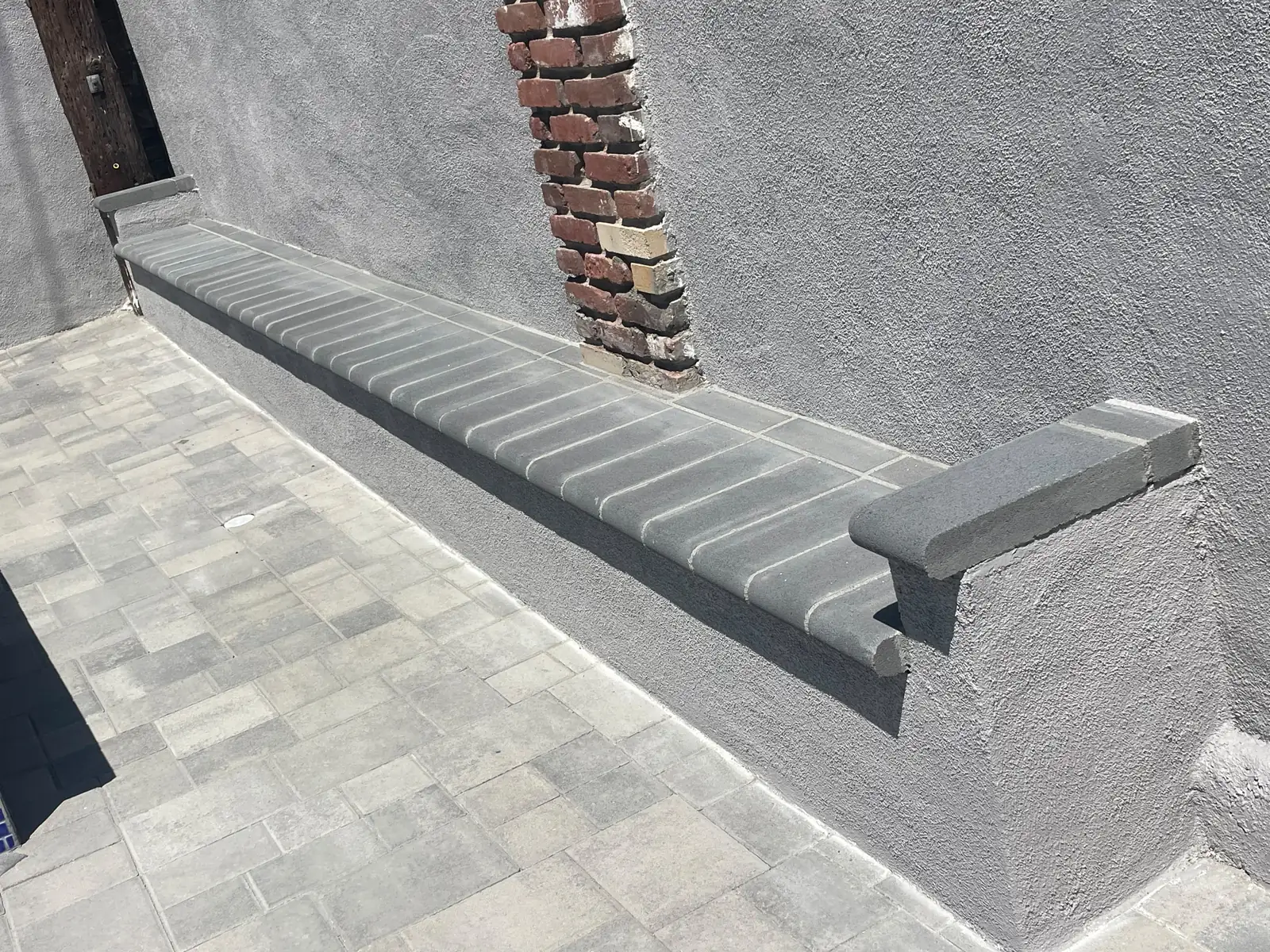
A retaining wall holds back soil; a seat wall is a low freestanding wall you sit on, often wrapped around a patio or fire pit. They look alike and are engineered completely differently. A residential retaining wall in Los Angeles usually costs $30–$95 per square foot of wall face installed — a 3 ft garden wall in the low thousands, a 5 to 6 ft engineered wall $17,000–$55,000 once engineering, permits and a geotechnical report are added. When an old wall is leaning or cracked, we rebuild it rather than patch it.
We do not publish a separate seat-wall price; the nearest reference is the 2–3 ft CMU garden wall at $120–$250 per linear foot in our retaining wall cost guide. For terracing and materials on slopes, see retaining wall ideas for hillside lots; for engineering and permits, our retaining wall contractor page.
Patio covers and pergolas
A patio cover is roofed and gives full or filtered shade; a pergola is an open frame of beams and rafters. A patio cover in Los Angeles typically costs $25–$110 per square foot installed, with Alumawood and aluminum lattice at the bottom of that range and insulated aluminum, wood and steel above it. We are an authorized Alumawood installer. A pergola usually costs $2,500–$6,500 for a 10×10 in aluminum lattice or wood, footings included, while a louvered motorized pergola is its own budget. See the patio cover cost guide and the pergola cost guide. Both land on footings that must be poured before the paving goes around them.
Outdoor kitchens
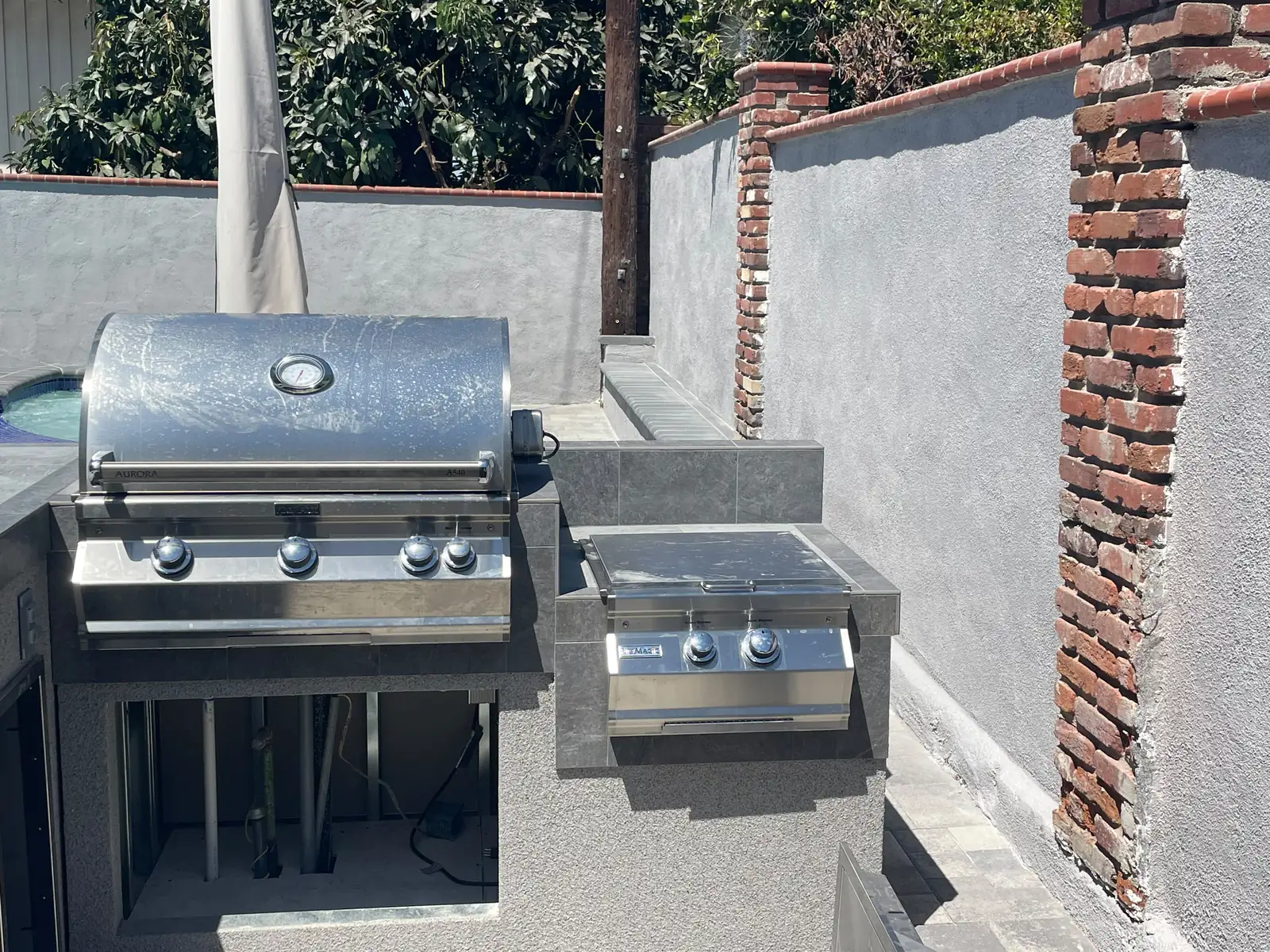
An outdoor kitchen is a built island — steel-stud frame, cement board, a stucco, stone or tile finish and a counter — with appliances set in and gas, electrical and sometimes plumbing run to it. In Los Angeles it usually costs $6,000–$16,000 for a grill island, $13,000–$35,000 with a sink and refrigerator, and $40,000–$85,000+ for a full kitchen with a pizza oven, a bar and a cover. Our outdoor kitchen cost guide prices it line by line, and our outdoor kitchens, decks and pergolas page covers design. The gas, electrical and plumbing are permitted trades, handled by licensed specialty contractors we schedule and supervise.
Fire pits and fire features
We do not publish a fire-pit price, because the cost is mostly the masonry around it and the gas run to it. Two published line items from our outdoor kitchen guide apply: a trenched, tested gas line with a shutoff at $12–$30 per linear foot, and outdoor electrical — a dedicated circuit, GFCI and lighting — at $1,000–$3,500. Plan the fire feature before the patio is poured, so the lines run under the paving instead of through it.
Artificial turf: the in-between material
Turf is not alive, but it is installed on an excavated, compacted base like pavers and it sheds water rather than absorbing it, so it sits between hardscape and softscape. A standard residential product costs $12–$18 per square foot installed in Los Angeles. A yard that drained fine as lawn can push water toward the foundation once it is turf. Our artificial turf cost guide compares it with sod and drought-tolerant planting.
Decks
A wood or composite deck is hardscape too, and on a sloped lot it is often the only way to get a flat outdoor floor without a tall wall. We build new decks; if you are weighing an old one, repair or replace your deck explains how to tell.
What hardscaping costs in Southern California
Hardscape is priced element by element, so the useful question is not “what does hardscaping cost” but “what do the pieces I want cost”. The table pulls the headline ranges from each of our Los Angeles cost guides. They are budgeting ranges, not a quote: your yard can come in lower or higher depending on access, soil, slope and finishes.
| Element | Typical Los Angeles installed range | Example from the guide | Full guide |
|---|---|---|---|
| Concrete patio, broom finish | $8–$18 per sq ft | 500 sq ft: $4,000–$9,000 | Concrete patio cost |
| Stamped concrete | $12–$26 per sq ft | 400 sq ft patio: $4,800–$10,400 | Stamped concrete cost |
| Paver patio, standard concrete pavers | $15–$25+ per sq ft (porcelain $25–$40; natural stone $25–$40+) | 500 sq ft: $7,500–$12,500 | Paver patio cost |
| Driveway replacement | Tear-out $1,500–$3,000, plus concrete at $8–$18 or pavers at $15–$25+ per sq ft | 600 sq ft two-car: $6,300–$13,800 concrete; $10,500–$18,000+ pavers | Driveway replacement cost |
| Retaining wall | $30–$95 per sq ft of wall face | 5–6 ft engineered wall: $17,000–$55,000 with engineering, permits and geotechnical report | Retaining wall cost |
| Patio cover | $25–$110 per sq ft | 12×20 aluminum cover: roughly $6,000–$18,000 | Patio cover cost |
| Pergola | 10×10 aluminum lattice or wood: $2,500–$6,500 | 12×16: $4,800–$12,500; louvered motorized 10×10: $6,000–$13,000 | Pergola cost |
| Outdoor kitchen | Grill island: $6,000–$16,000 | With sink and refrigerator: $13,000–$35,000; full kitchen: $40,000–$85,000+ | Outdoor kitchen cost |
| Artificial turf, standard | $12–$18 per sq ft | 600 sq ft back lawn: $7,200–$10,800 | Artificial turf cost |
| Complete backyard remodel | $13,000–$70,000 | The sum of the pieces above, plus drainage, electrical and permits | Backyard remodel cost |
Three extras show up on almost every hardscape bid and catch people out: demolition and haul-away of an old slab at $1,500–$3,000, difficult access (wheelbarrow instead of a Bobcat) adding $500–$1,500+, and drainage at about $90 per linear foot where the yard cannot shed water on its own. If one bid is far below the others, it is usually missing one of these, or a thinner base.
How to plan a hardscape project in a Southern California yard
Start with where the water goes
Every square foot of new paving is a square foot that no longer absorbs rain. The California Residential Code sets the baseline in Section R401.3: the lot must be graded so surface water drains away from the foundation, falling at least 6 inches within the first 10 feet. Where a wall, slope or lot line makes that impossible, drains or swales have to carry the water away instead, and impervious surfaces within 10 feet of the foundation must slope at least 2 percent away from the house — about a quarter inch per foot. A patio laid dead level against the back wall is the most common hardscape mistake we are called to fix.
Decide early where the water ends up: the street, an approved drain line, or a dry well where the site allows it. Area drains and channel drains are cheap to set before paving and expensive to add after.
Respect the soil and the base
Most hardscape failures are base failures. Clay soils swell when wet and shrink when dry, and a slab or paver field laid over loose or expansive soil moves with it. The fix is excavation to firm ground, a compacted aggregate base placed and compacted in lifts rather than dumped in one pass, and the right thickness for the load — a patio, a hot tub and a driveway are three different specifications. On our Anaheim project the base went down in lifts with each one compacted before the next, because a compactor only densifies the top few inches.
Sequence the work: hardscape first, plants last
The order of a backyard build decides how much gets dug up twice. This is the sequence we follow:
- Design and levels. Lay the yard out as zones people move between — cooking, eating, lounging, a path to the side gate — set finished heights, and draw the drainage before choosing materials. Our outdoor living design ideas cover zoning a Southern California yard.
- Demolition and rough grading. Old slabs, lawn and roots out; the yard cut to the new levels.
- Everything underground. Drain lines, the gas line to a grill or fire pit, electrical conduit for lights and outlets, and irrigation sleeves under any paving that will separate planters.
- Footings and walls. Retaining walls, seat walls, and the footings for a pergola, a patio cover or a kitchen island — poured before the paving goes around them.
- Base and paving. Concrete or pavers, edges and steps.
- Structures and finishes. Cover or pergola framing, kitchen island finish, appliances, lighting.
- Softscape. Soil preparation, irrigation, planting and turf, laid around finished hardscape rather than trampled during it.
Do you need a permit for hardscaping in Los Angeles?
Often not for flat paving, often yes for walls, covers, gas and electrical. In the City of Los Angeles the list of work that needs no building permit is in LAMC Section 91.106.2, with retaining walls and pergolas covered by the scope exclusions in LAMC Section 91.101.5. Here is how those rules land on common hardscape:
| Element | City of Los Angeles rule | Source |
|---|---|---|
| On-grade patio, walkway or driveway on your lot | No building permit for platforms, walks and driveways not more than 30 inches above grade and not over a basement or story below | LAMC 91.106.2, item 5 |
| Driveway apron, curb or sidewalk in the street | A separate A-Permit from the Bureau of Engineering for work in the public right-of-way | BOE A-Permit |
| Retaining wall | Exempt only if not over 4 ft from the bottom of the footing to the top, and not supporting a surcharge or sloping earth. No exemption at any height on a slope steeper than 1:5 (20%) | LAMC 91.106.2, item 17; 91.101.5, item 4 |
| Freestanding masonry or concrete wall, including most seat walls | No permit up to 3½ ft high | LAMC 91.106.2, item 13 |
| Pergola | Outside the building code if freestanding, not over 400 sq ft, and outside any fire district; an attached pergola is not covered by that exclusion | LAMC 91.101.5, item 7 |
| Patio cover attached to the house | Not on the exempt list (only awnings projecting 4 ft or less from the wall are) — plan on a permit | LAMC 91.106.2, item 9 |
| Small jobs generally | Work valued at $2,500 or less is exempt unless it affects structural stability or public safety, follows a Department order, or changes the use | LAMC 91.106.2, item 1 |
| Gas line or new circuit to a kitchen, fire pit or lights | Separate plumbing and electrical permits | Trade permits |
These are City of Los Angeles rules; Glendale, Burbank, Pasadena, the unincorporated County and the Orange, Ventura and Inland Empire cities set their own. A permit exemption does not exempt work from zoning setbacks, height limits or HOA approval, and a hillside lot changes the answer for walls and grading almost every time. This is general information, not legal advice; your building department has the final word on your parcel.
Who builds hardscape: hardscape contractor, landscaper or general contractor?
“Hardscape contractor” is a description, not a California license. The Contractors State License Board licenses the trades that do the work, and its classification list is the place to check who can build what:
- C-8 Concrete — forms, pours, places and finishes concrete, including pavement and flatwork.
- C-29 Masonry — block, brick and stone, including walls and fences built with or without mortar, and paving.
- C-27 Landscaping — builds and installs landscape systems that improve the grounds around a structure, and grades the land for them; the classification covers both planting and the architectural treatment of a yard.
- B General Building — a general contractor may take a prime contract for a project that involves at least two unrelated trades other than framing or carpentry, or one where it holds the specialty classification or subcontracts the work to an appropriately licensed specialty contractor.
In practice: a single paver patio is specialty work, and a C-8, C-29 or C-27 contractor can do it well. A backyard with a retaining wall, a pergola on footings, an outdoor kitchen with gas and electrical, drainage and paving is several trades that have to be sequenced around each other, which is what a general contractor coordinates. Whoever you hire, look the license up on the CSLB site before you sign, and make sure the written contract names who handles the drainage — it is the item that most often belongs to nobody.
What a complete hardscape project looks like
Our Encino backyard project is close to the full list in this article in one yard. The homeowner had a dated yard around an existing pool and asked for ideas and a 3D design. The finished scope was demolition and grading, a renovated pool with a new raised spillover spa, Angelus paver decking, stucco perimeter and retaining walls with brick pilasters, a built-in paver bench and an outdoor kitchen with a grill, side burner, sink and under-counter refrigeration — one design, one contract, three months from the first machine on site to handover.
For the wider picture of what we build outside — covers, kitchens, paving and full yards — see our outdoor living and backyard remodeling page.
Hardscaping mistakes we see most often
- Paving toward the house. A patio with no fall, or the wrong fall, sends every storm at the foundation.
- Pouring before running the gas and conduit. Adding a grill line or outdoor outlet later means saw-cutting new concrete.
- Treating a retaining wall like a garden wall. Height, slope and anything sitting above the wall decide whether it needs an engineer and a permit, not how short it looks.
- Comparing bids that are not the same job. Check that each one includes demolition, base depth, drainage and access.
Hardscaping FAQs
What is considered hardscaping?
Anything built from non-living material in a yard: concrete and stamped concrete patios, paver patios and pool decks, driveways, walkways, steps, retaining walls, seat walls, patio covers, pergolas, decks, outdoor kitchens and fire pits. The edging, drains and compacted base under the paving count too.
What is the difference between hardscape and landscape?
Landscape is the whole outdoor space. Hardscape is the built part of it — paving, walls and structures — and softscape is the living part: lawn, plants, trees and soil. “Hardscape vs. landscape” usually means hardscape vs. softscape.
What is the least expensive hardscape?
Of the surfaces we price, a broom-finish concrete slab is the least expensive permanent option at $8–$18 per square foot installed in Los Angeles, against $12–$26 for stamped concrete and $15–$25+ for standard concrete pavers. Pavers cost more up front but can be lifted and re-laid, which matters when the ground moves.
Should hardscaping or landscaping go in first?
Hardscape first. Grading, drainage, underground lines, walls, footings and paving all involve excavation and heavy equipment, and planting done before them gets trampled or dug back up. Softscape and irrigation go in last, fitted around the finished paving and walls.
Do I need a permit for a patio in Los Angeles?
For an on-grade concrete or paver patio in the City of Los Angeles, usually not: LAMC 91.106.2 exempts platforms, walks and driveways not more than 30 inches above grade and not over a basement or story below. A cover over the patio, a retaining wall over the exemption limits, a gas line or a new circuit each need their own permit, and other cities set their own rules.
What license does a hardscape contractor need in California?
There is no “hardscape” license. Concrete falls under C-8 Concrete, block, brick, stone and paving under C-29 Masonry, and yard construction under C-27 Landscaping; a B general building contractor coordinates multi-trade projects. Check any license on the CSLB website before signing.
Is artificial turf hardscape or softscape?
It sits in between. Turf is not alive and needs no mowing or watering, but it is installed on an excavated, compacted base like pavers and it sheds water rather than absorbing it, so it has to be planned with the drainage.
How long does a hardscape project take?
A single element is quick once materials are on site: a 600 square foot turf lawn takes two to three days, and an attached Alumawood patio cover one to three days to install after the permit. A full backyard remodel usually takes one to ten weeks on site depending on how many elements are in it, and permits, engineering and HOA review can add weeks before work starts. Our Encino yard with a pool renovation, walls, paving and an outdoor kitchen took three months.
Plan your hardscape with one team
The best-looking patio fails if the water runs the wrong way, and the best-built wall is wasted if the gas line has to be trenched through it later. We design the yard as one project — levels, drainage, walls, paving, structures and utilities — and give you a written scope you can compare line by line against anyone else’s. Site visits take about two hours, and proposals follow within 48 hours. Call (800) 348-3050, 8am–6pm daily, or request a free estimate online.