
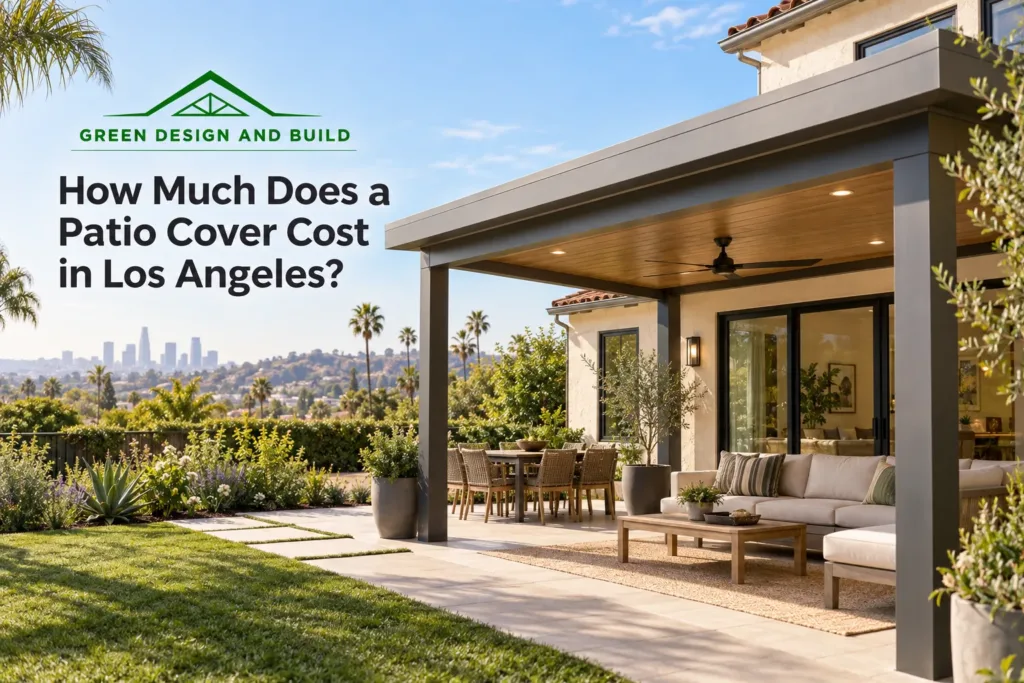
A patio cover in Los Angeles typically costs $25 to $110 per square foot installed, which puts a common 12 by 20 foot aluminum cover at roughly $6,000 to $18,000 depending on the material, whether it is attached to the house or freestanding, and whether it needs a permit, engineering and electrical. Green Design and Build is a licensed general contractor (CSLB #1110975) based in Van Nuys that designs, permits and builds patio covers for homeowners across Los Angeles County, Orange County, Ventura County, western Riverside County and western San Bernardino County. The figures on this page are typical Los Angeles budgeting ranges, not a quote; the number for your yard depends on the site and the product you choose. A patio cover is usually one part of a larger project; our backyard remodel cost guide prices the paving, fencing, electrical and drainage that normally go with it.
On this page
- Patio cover cost by material
- What changes the price of a patio cover
- When is a permit required for a patio cover?
- How long does a patio cover take?
- A real example of choosing the right material
- How to compare patio cover quotes
- Where we build patio covers
- Patio cover cost FAQs
- Get a written patio cover price for your yard
Patio cover cost by material
The material is the biggest single driver of price. The table shows installed budgeting ranges for a standard rectangular cover on an existing concrete patio, including posts, beams, roof panels and basic attachment to the house. It excludes permits, engineering, electrical, footings for freestanding covers and any new concrete.
| Material | Installed cost per sq ft | 10 x 12 (120 sq ft) | 12 x 20 (240 sq ft) | 14 x 24 (336 sq ft) |
|---|---|---|---|---|
| Alumawood or aluminum lattice (open, filtered shade) | $25 to $45 | $3,000 to $5,400 | $6,000 to $10,800 | $8,400 to $15,100 |
| Alumawood solid (flat pan or W-pan, full shade) | $30 to $55 | $3,600 to $6,600 | $7,200 to $13,200 | $10,100 to $18,500 |
| Insulated aluminum (3-inch foam-core panel) | $45 to $75 | $5,400 to $9,000 | $10,800 to $18,000 | $15,100 to $25,200 |
| Wood (Douglas fir or redwood, solid or lattice) | $40 to $80 | $4,800 to $9,600 | $9,600 to $19,200 | $13,400 to $26,900 |
| Steel (custom, long spans) | $60 to $110 | $7,200 to $13,200 | $14,400 to $26,400 | $20,200 to $37,000 |
Two notes on the table. Small covers rarely hit the bottom of the per-square-foot math, because a crew, a delivery and a permit cost about the same at 120 or 240 square feet; budget a floor of about $4,000 to $5,000 for anything installed and permitted. And the ranges overlap on purpose: a solid Alumawood cover with a fan and lights can cost more than a bare insulated one. For one common size worked through from a basic aluminum cover to a custom freestanding one, see what a 12×20 patio cover costs.
Alumawood patio cover cost
Alumawood is embossed aluminum that reads as painted wood from a few feet away, and it is what we recommend most often across Los Angeles. It does not rot, warp or feed termites, never needs staining, and takes the afternoon sun on a west-facing Valley yard without fading badly. An Alumawood patio cover typically costs $25 to $45 per square foot for lattice and $30 to $55 for a solid roof, installed. Lattice gives filtered shade; solid gives full shade and rain protection and can carry recessed lights and a ceiling fan.
Insulated patio cover cost
An insulated patio cover uses a three-inch foam-core aluminum panel, and it is the material to choose if you want an outdoor room rather than a shade structure. It stops radiant heat far better than a single-skin pan, gives a finished ceiling, and carries fans, lights, speakers and heaters inside the panel. An insulated patio cover typically costs $45 to $75 per square foot installed, so a 12 by 20 cover in Los Angeles lands around $10,800 to $18,000 before electrical.
Wood patio cover cost
A wood patio cover in Los Angeles typically costs $40 to $80 per square foot installed, Douglas fir at the lower end, redwood and heavy custom beams at the upper end. Wood is the right choice when the house has real architectural character or the design calls for decorative rafter tails and oversized beams. The trade-off is maintenance: sealing or repainting every few years, and in a Valley summer an unsealed beam will check and gray inside two seasons. Our patio cover materials guide covers the pros and cons of each material in more depth.
Steel patio cover cost
Steel is the least common choice for a standard backyard and the most expensive, typically $60 to $110 per square foot. It earns its place for a long clear span with no mid posts, a cantilever, or a very thin modern roof profile. Steel needs engineering, a rust-protective finish and a welding crew; most homeowners who ask about steel end up with insulated aluminum once they see the numbers.
What changes the price of a patio cover
Beyond the material, six things move a patio cover quote up or down. When two bids for the same yard are far apart, one of them usually left some of these out.
Attached or freestanding
An attached cover fastens to the house with a ledger board bolted through the stucco into the framing and uses the house for half its support. A freestanding cover needs four or more posts, each on its own concrete footing, plus a stiffer frame. Budget roughly $1,500 to $4,000 more for freestanding than for the same cover attached. It is still the right call when the house has a low eave line, a second-story deck or a roof edge that cannot take a ledger.
Footings and the existing slab
On an existing patio slab, the posts are normally anchored to new footings cut through the slab, not to the slab itself, because a four-inch patio slab is not designed to carry point loads or resist wind uplift. Expect two to four footings on an attached cover and four to six on a freestanding one. If there is no concrete, a new patio slab is priced separately, in the same range as other residential flatwork, roughly $8 to $18 per square foot. Pavers are an alternative surface; see our paver installation page.
Permits, plan check and engineering in Los Angeles
In the City of Los Angeles, which includes Van Nuys, Sherman Oaks, Encino, Studio City, Woodland Hills, Northridge and North Hollywood, permits are issued by LADBS. Permit and plan-check fees for a residential patio cover typically run $400 to $1,500. Manufactured aluminum systems usually come with an ICC evaluation report and pre-engineered span tables, which is why they can often be permitted over the counter or through an express process. Wood and steel covers, freestanding covers, hillside lots and anything outside the manufacturer’s span tables generally need a stamped engineering letter or drawings, typically $800 to $2,500. Burbank, Glendale, Pasadena, Santa Clarita, Long Beach, Torrance and every Orange County city run their own building divisions; unincorporated areas go through LA County, Ventura County or Riverside County Building and Safety.
Electrical for fans, lights and heaters
A ceiling fan, recessed lights, an outlet for a TV or an infrared heater all need a circuit run from the panel to the cover, conduit through the beam or panel, and a separate electrical permit and inspection. On our projects this work is performed by our licensed specialty-trade partners under our management. Budget roughly $1,000 to $3,500 depending on distance from the panel and the number of fixtures. If the house still has a 100-amp panel from the 1960s, common in Valley ranch houses, adding a patio circuit may be the moment it needs an upgrade; that is a separate line item and we tell you before you sign.
Wind, seismic and fire zones
Patio covers are designed for wind uplift and seismic loads, which is why post embedment, hardware and beam sizing matter more than the roof panel. In the hills above the Valley, Malibu, the Santa Clarita Valley and much of Ventura County, lots fall inside Very High Fire Hazard Severity Zones, where attached covers are treated as part of the house and must meet Chapter 7A ignition-resistant requirements. That usually rules out untreated wood and adds cost.
HOA and CC&R review
In master-planned Orange County communities and newer tracts in Santa Clarita, Eastvale and Corona, HOA architectural review runs alongside the city permit; our page on patio covers in the Inland Empire covers Corona, Eastvale and the cities around them. Most HOAs restrict height, color and street visibility; some forbid lattice. Approval costs little but can add several weeks if the committee meets monthly.
When is a permit required for a patio cover?
Generally, a building permit is required in the City of Los Angeles for any patio cover attached to the house, and for a freestanding cover larger than 120 square feet. A detached, one-story accessory structure of 120 square feet or less may fall under the building-permit exemption in the California Residential Code; confirm with the LADBS counter that it applies to your cover before you rely on it, because three cautions apply: zoning setback and lot-coverage rules still apply even when a building permit does not; the exemption is for the structure only, so any electrical still needs its own permit; and 120 square feet is smaller than most people picture, roughly 10 by 12 feet. Other cities follow the same state code baseline and add their own rules, so confirm with the local building division before assuming a small cover is exempt.
Skipping the permit on an attached cover is a bad trade. An unpermitted structure shows up in a sale or a refinance appraisal, it can void a homeowner’s insurance claim if it fails in a windstorm, and LADBS can require you to open it up for inspection or remove it. We pull the permit on every attached cover we build.
Sources: LADBS, Building Permits (the work that requires a permit in the City of Los Angeles); Los Angeles Municipal Code section 91.106, Permits (section 91.106.2 lists the work exempt from a building permit in the City of Los Angeles).
How long does a patio cover take?
| Stage | Typical time |
|---|---|
| Site visit, design and written quote | About a week |
| Engineering (if required) | One to two weeks |
| HOA review (if applicable) | Three to eight weeks, in parallel |
| Permit: manufactured aluminum, over the counter or express | Days to two weeks |
| Permit: wood, steel, freestanding or hillside plan check | Three to eight weeks |
| Installation: Alumawood or insulated aluminum, attached | One to three days |
| Installation: wood | One to two weeks including finish |
| Freestanding: add footing pour and cure before framing | About one extra week |
| Electrical rough-in, finish and inspection | One to two days, scheduled inside the build |
These are typical Los Angeles budgeting estimates, not a price list or a quote. Your project can come in lower or higher depending on the house, the scope and the finishes; the only real number is a written proposal after a site visit.
From signed contract to finished cover, most attached aluminum projects in the Valley run three to six weeks, with the permit taking most of that. Wood, freestanding and HOA projects also land in the three-to-six-week range once approvals are in hand.
A real example of choosing the right material
In our materials guide we describe a homeowner who came to us set on wood for its warmth. Once we talked through how the family used the yard, the picture changed: most evenings outside, a west-facing patio that baked after 3 PM, no appetite for restaining, and a wish list of recessed lights and ceiling fans. We recommended insulated aluminum. They got full shade, a finished ceiling that carried the fans and lights, and a structure they have not had to touch since. The budgeting lesson: choose the material for how you will use the space, then price it.
How to compare patio cover quotes
Ask every bidder for the same five things in writing; the cheap quote usually stops being cheap.
- The exact product: manufacturer, panel type (lattice, flat pan, W-pan, insulated and its thickness), color and gauge.
- Attachment method and footings: ledger through stucco or freestanding, number of footings, depth and size.
- Permit and engineering: who pulls it, whether fees are included, whether engineering is included or excluded.
- Electrical: what “lights and fan included” means, how many fixtures, whether the circuit and electrical permit are included.
- What happens to what is already there: stucco patching at the ledger, gutter and downspout, concrete cutting for footings, disposal of an old cover, landscape repair.
Green Design and Build puts all five in the proposal. Read more on our patio covers service page, or see how a cover fits into a wider outdoor living or backyard remodeling project.
Where we build patio covers
We build patio covers from our Van Nuys office across the San Fernando Valley, the rest of Los Angeles County, Orange County, Ventura County, western Riverside County and western San Bernardino County.
Related cost guides: Pergola cost · Outdoor kitchens, decks and pergolas · Outdoor kitchen cost · Concrete patio cost · Backyard remodel cost
If you plan to finance the work, our financing page explains the programs we offer and how progress payments work under California law.
Patio cover cost FAQs
How much does a patio cover cost in Los Angeles?
A patio cover in Los Angeles typically costs $25 to $110 per square foot installed, or about $6,000 to $18,000 for a common 12 by 20 foot aluminum cover, before permits, engineering and electrical. Lattice aluminum is the least expensive, insulated aluminum and wood sit in the middle to upper range, and custom steel is the most expensive. These are typical Los Angeles budgeting ranges, not a quote.
How much does an Alumawood patio cover cost?
An Alumawood patio cover typically costs $25 to $45 per square foot installed for lattice and $30 to $55 per square foot for a solid roof in the Los Angeles area. That puts a 12 by 20 solid Alumawood cover at roughly $7,200 to $13,200. Fans, lights, a permit and freestanding footings are extra.
How much does an insulated patio cover cost?
An insulated aluminum patio cover typically costs $45 to $75 per square foot installed in Los Angeles, so a 12 by 20 insulated cover runs about $10,800 to $18,000 before electrical. The premium over a solid Alumawood roof buys a three-inch foam-core panel that blocks radiant heat, gives a finished ceiling and carries fans, lights and heaters inside the panel.
Do I need a permit for a patio cover in Los Angeles?
Generally, yes for any patio cover attached to the house, and for a freestanding cover larger than 120 square feet, with the permit issued by LADBS in the City of Los Angeles. A detached cover of 120 square feet or less may be exempt from a building permit under the California Residential Code; confirm that with LADBS before relying on it, because zoning setbacks still apply and any electrical needs its own permit. Other cities and the county follow the same baseline with their own procedures.
Is a freestanding patio cover more expensive than an attached one?
Yes. A freestanding patio cover typically costs $1,500 to $4,000 more than the same cover attached to the house, because it needs more posts, a concrete footing under each one and usually an engineering stamp. It is the right choice when the roof edge or eave cannot take a ledger board or when you want the cover away from the house.
How long does it take to install a patio cover?
Installing an attached Alumawood or insulated aluminum patio cover usually takes one to three days once the permit is issued. Wood covers take one to two weeks including finish, and freestanding covers add about a week for footings to cure. From signed contract to completion, most attached aluminum projects in Los Angeles run three to six weeks, with the permit taking most of that time.
Does a patio cover add value to a home?
A well-built, permitted patio cover generally adds usable living space and buyer appeal in Southern California, where outdoor rooms are used most of the year. An unpermitted cover can do the opposite: it can be flagged in an appraisal or inspection and become a negotiating point or a removal order. Permitted, documented work is the version that helps at resale.
Can I add lights and a fan to a patio cover later?
Yes, but it is cheaper to plan the electrical before the cover goes up. On a solid or insulated aluminum cover the wiring runs inside the beam or panel, so adding it later means opening finished parts of the structure. If you think you might want a fan or lights, have the circuit and the mounting blocks installed during the build, even if the fixtures come later.
Get a written patio cover price for your yard
We will measure the patio, check the eave and the panel, tell you whether your city needs a permit, and give you an itemized quote that lists the exact product, footings, permit and electrical. The site visit and the estimate are free.