
Most cracked driveways do not need replacing. A driveway needs repair when the damage is cosmetic or confined: hairline cracks, a crack inside a control joint, a chipped edge. It is a candidate for resurfacing when the slab is flat, sound and well drained but the top has flaked or worn. It needs replacement — of one section or all of it — when the problem is underneath: panels that have sunk or lifted so one side of a crack sits higher than the other, tree roots pushing the slab up, water running toward the garage, or cracks that come back after they are filled. The quickest test is whether the surface is the problem or the symptom. If it is the symptom, a repair or an overlay only hides it until the next rainy season.
We are Green Design and Build, a licensed residential general contractor based in Van Nuys (CSLB #1110975), working across Los Angeles, Orange and Ventura counties and western Riverside and San Bernardino counties. To be clear up front: we replace driveways — failed sections or the whole driveway — and we do not do crack sealing, patching or resurfacing. Those are smaller jobs that concrete repair, slab-lifting and paving companies do well, and this guide says when one of them is the right call. There are no prices here on purpose: driveway numbers depend on the slab, the soil, the access and the apron, and the only honest figure comes from a site visit.
Repair, resurfacing or replacement: the short version
The three words get used loosely. Here is what each means on a concrete driveway, and who usually does it.
| Option | What it involves | Works when | Fails when | Usually done by |
|---|---|---|---|---|
| Crack sealing and patching | Filling cleaned-out cracks with flexible sealant; patching chips and small holes | Hairline cracks, joint cracks, small spalls on a level slab | One side of the crack is higher, or the crack is still moving | Handyman or concrete repair company |
| Slab lifting | Pumping grout (mudjacking) or expanding foam under a sunken panel | A panel that dropped in one piece | Broken or root-heaved panels; water still washing out the base | Concrete leveling company |
| Resurfacing | A thin bonded cement-based overlay on the existing slab | Sound, level, well-drained slab with a worn or scaled top | Slab cracked through, uneven or moving | Resurfacing or decorative concrete contractor |
| Section replacement | Saw-cutting out panels at the joints, fixing the base, pouring new | Damage confined to a few panels; drainage works | The base or the slope is wrong across the whole driveway | General or concrete contractor — work we do |
| Full replacement | Removing the whole slab, rebuilding the base, regrading, new concrete or pavers | Widespread failure, wrong drainage, a new size, layout or material | Rarely the wrong answer when the base has failed — just the most involved | General or concrete contractor — work we do |
Our driveway replacement service in Los Angeles covers the last two rows. If your driveway fits the first three, a specialist is the right call, and we would rather tell you that than sell you a slab you do not need.
Is the problem the surface or what is under it?
A concrete driveway is a thin slab — typically four inches for cars — on compacted soil and crushed aggregate base. It cannot span a hole, so when the ground under it settles, swells or washes out, the slab cracks to follow. Surface problems (shrinkage cracks, flaking, worn finish, chips) leave the base fine, and repair or resurfacing works. Support problems (settled fill, expansive clay, roots, a leaking line, years of water under the slab) come back after a surface fix because nothing touched the cause.
Three questions sort most driveways. Is the surface still in one plane, or can you feel a lip with your foot? Has the crack changed since last year? Where does the water go when it rains? If the answers are “flat, no change, toward the street,” it is a surface repair. If any answer goes the other way, keep reading.
Reading the cracks
Concrete cracks; the straight control joints cut across a driveway exist so it cracks where you want it to. What a crack looks like tells you what caused it.
Hairline cracks and cracks inside joints
Fine, wandering cracks, often appearing in the first year, are usually shrinkage from curing; a crack inside a control joint is the joint doing its job. If both sides are level and nothing is growing, it is cosmetic. Seal it to keep water out of the base.
A crack where one side sits higher
This is the one that matters. A vertical offset means the two pieces are no longer supported the same way: one has settled or the other has been pushed up. Sealant cannot level it, and grinding the lip removes the trip hazard, not the movement. An intact panel that dropped may be liftable; a broken, root-heaved or washed-out one needs to come out.
A crack that keeps widening or reopening
Continuing movement is a support problem by definition. Mark both ends of the crack in pencil with the date and look again after the rainy season. If it has grown or the filler has torn, resealing buys a season at most.
Corner breaks and crumbling edges
A broken corner or an edge crumbling where tires run off the slab usually means the edge was never supported properly. One corner can be patched or cut out; edges failing all along the driveway point to how it was built, and that tends to be a replacement conversation.
Cracks near the house
A driveway crack is not a foundation crack, but they share causes. If the garage slab or the house is cracking too, read our guides to which foundation cracks are normal and which are not and the warning signs a foundation needs repair before deciding anything about the driveway.
| What you see | Likely cause | Usual answer |
|---|---|---|
| Fine random cracks, slab level | Shrinkage during curing | Seal or leave |
| Crack inside a control joint | Normal shrinkage at the joint | Seal the joint |
| One side of the crack higher | Settlement or heave under the slab | Lift the panel if intact; otherwise replace the section |
| Crack growing or reopening | Ongoing movement, often water or roots | Find the cause; section or full replacement |
| Slab tented up near a tree | Root heave | Root work plus section replacement, or pavers |
| Flaking, pitted or worn top | Scaling, spalling or wear | Resurface if the slab is sound |
| Water ponding or flowing to the garage | Wrong slope or settled panels | Regrade — usually replacement |
Settling and sinking panels
A sunken panel usually sits on soil that was never compacted properly or on base that water has been washing out. In older Los Angeles neighborhoods that often means a driveway poured over backfill against the garage, over a sewer-lateral trench, or over fill placed when the lot was graded decades ago.
If the panel dropped in one piece, slab lifting is a legitimate repair: mudjacking pumps cement-based grout under the slab through drilled holes, and foam lifting uses expanding polyurethane. Neither changes the soil that let it sink, so a panel sinking because a downspout empties against it will sink again until the water is redirected. When the sunken area is broken, several panels have gone, or the low spot collects water every storm, replacing the section on a new compacted base is the permanent fix.
Heaving from tree roots
Roots lift a slab from below until it tents up and cracks along the crest, often taking the apron and sidewalk with it. No surface repair helps: the panel comes out, the root is dealt with, and the section is rebuilt. How depends on whose tree it is:
- A tree on your property: have an arborist assess it before anyone cuts. Cutting a major root can destabilize a tree, and a root barrier is often better than heavy pruning.
- A City street tree: in the City of Los Angeles, removing, pruning or trimming the roots of a street tree may require a separate permit from the Bureau of Street Services’ Urban Forestry Division, according to the Bureau of Engineering permit manual. Sort that out before the saw comes out.
Where a tree will keep growing beside the slab, we often suggest pavers for the replacement: a paver section can be lifted along a root or utility trench and relaid with the same units, where concrete can only be cut and patched. The paver driveway and side yard we built in Anaheim shows that construction from excavation to drains at the low points, and our paver installation page covers the base a driveway needs.
Drainage problems a repair cannot fix
Look at the driveway during or right after rain. Water should run away from the garage and the house toward the street or a drain. If it ponds, runs back toward the garage or disappears into a crack, the base is getting wet every storm.
Section R401.3 of the 2025 California Residential Code requires lots to be graded so surface water drains away from foundation walls, with at least 6 inches of fall in the first 10 feet; where lot lines or other barriers prevent that, impervious surfaces within 10 feet of the foundation must slope at least 2 percent away from the building, with drains or swales to carry the water. A driveway that has settled toward the garage, or was poured flat, works against that.
Slope is set when the base is built, so sealant and overlays cannot change it. Correcting it means removing the affected area, regrading and pouring at the right fall, sometimes with a trench drain at the garage where it sits below the street. It is the most common reason a driveway that looks merely cracked needs replacing.
Spalling, scaling and what resurfacing can do
Scaling is the top layer flaking off in thin sheets; spalling is deeper, with pieces popping out of the surface, sometimes over reinforcement set too close to the top. In Southern California these tend to trace to a finish that was overworked or wetted during placement, a surface that dried too fast in summer heat, or years of water and chemicals. They are what resurfacing is for: bonding a thin layer of a cement-based product over the cleaned and prepared slab. On a sound, level, well-drained slab it renews the surface with far less disruption than tear-out. Its limits:
- It copies the slab beneath. A moving crack reflects through the overlay, usually along the same line.
- It cannot change the slope. Water that ran the wrong way still runs the wrong way.
- It only lasts if it bonds. Oil, old sealers or a weak, dusty top have to be cleaned or ground off first.
- It adds height at the garage door and where the driveway meets the apron and sidewalk.
Pouring a full new slab over the old one is a different idea, and one we steer people away from: it raises the driveway above the garage slab and apron, cracks where the old slab is cracked, and leaves the failed base underneath. Our driveway replacement cost guide explains why tear-out and a new compacted base is the better spend once a driveway has failed.
Asphalt driveways: same logic, different vocabulary
Asphalt follows the same rule — treat the surface if the surface is the problem, rebuild if the base is. Sealcoating protects an oxidizing, graying surface and is maintenance, not a structural fix. Crack filling keeps water out of isolated cracks, patching replaces a pothole or soft spot, and an overlay adds a new layer of asphalt over a sound base with a worn-out surface. Replacement removes the asphalt and rebuilds the base.
Interconnected cracking that looks like reptile scales — alligator cracking — and ruts or soft spots that deform under tires generally point to the base, which is when an overlay stops making sense. We do not install or repair asphalt; paving contractors do. Where we come in is when the decision is to take the asphalt out and replace it with concrete or pavers.
Section replacement or full replacement?
There is no fixed percentage that tips a driveway from partial to full replacement. These are what we weigh on site:
- Is the damage confined? One or two root-heaved panels with the rest level and sound is a good case for cutting out sections at the joints.
- Is the base sound elsewhere? If the cause runs under the whole driveway, replacing two panels just schedules the next two.
- Does the slope work? A new section has to meet the grades around it, so changing the fall usually means a larger replacement.
- Will it match? New concrete will not match years of weathering — often acceptable on broom finish, rarely on stamped or colored concrete.
- Are you changing anything? A wider driveway, a new material or a conversion from asphalt is a full replacement.
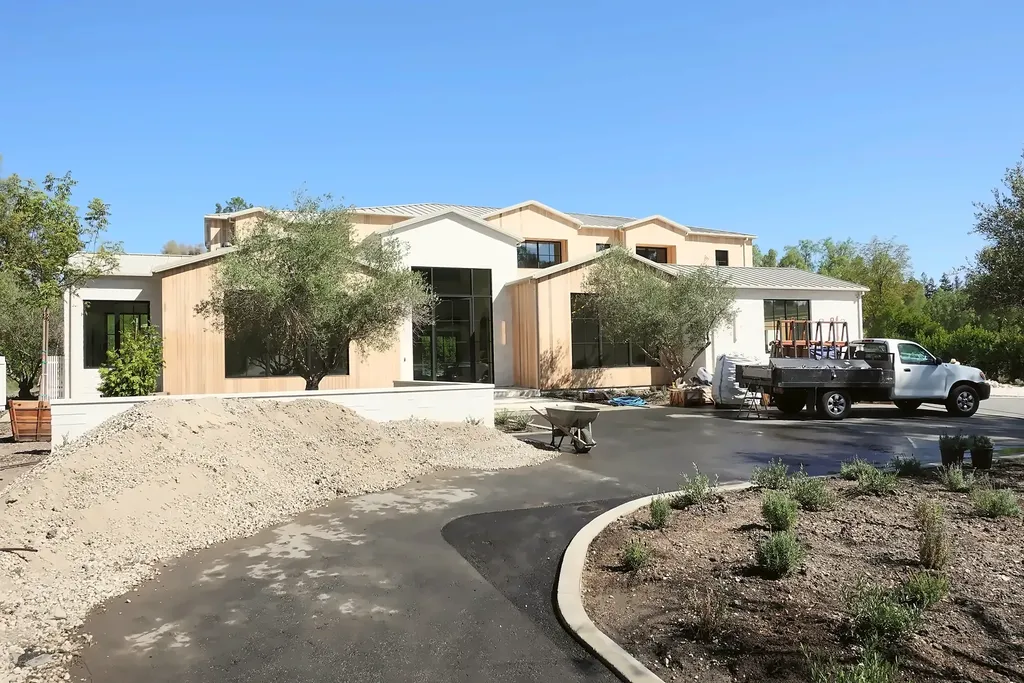
A section replacement is not a lesser job: saw-cut at clean lines, base excavated, compacted and corrected, and the new panel formed to meet the old slab at the right height and fall. Our concrete construction page describes how we build that base and slab, which is where most driveway failures start.
The apron, the sidewalk and the city permit
The driveway approach — the apron between sidewalk and street, the curb cut and the sidewalk crossing — is not part of your lot. It sits in the public right-of-way. In the City of Los Angeles:
- It needs an A-Permit from the Bureau of Engineering. The Bureau’s permit manual defines A-Permits as covering the repair, construction or reconstruction of curbs, sidewalks, driveway approaches or gutters, says the applicant is generally the property owner or their representative, and requires the work to follow the Greenbook standard specifications.
- It is built to the City’s design. The driveway construction, modification or replacement procedure points standard driveways to City Standard Plan S-440-4, and its sample permit conditions direct the applicant to call the Bureau of Contract Administration for a pre-inspection.
- Avenues and Boulevards need LADOT first. An approved LADOT Driveway Approach Data Sheet is required before the permit is issued.
- Abandoned driveways get closed. Old curb cuts must be replaced with full-height curb and sidewalk, so moving a driveway means closing the old one.
Who pays for a cracked apron? The City’s sidewalk rebate program reimburses eligible owners for part of the cost of repairs that bring a non-compliant sidewalk up to ADA requirements. Its rebate program FAQ includes the apron only if it must be altered to make the sidewalk compliant — not where the apron is damaged but the sidewalk is fine — and says the applicant hires a licensed contractor of their choosing. As of October 2026 the program’s page says new applications go on a waitlist.
Other cities — Burbank, Glendale, Pasadena, Long Beach and those across Orange, Ventura, Riverside and San Bernardino counties — run their own encroachment or public works permits with their own standard drawings. We confirm the rules with the city before pricing an apron, and if the cracked apron needs replacing anyway, the driveway job is the time to do it.
Do you need a permit for the driveway itself?
Usually not, for the part on your property. Los Angeles Municipal Code section 91.106.2 exempts from building permits platforms, walks and driveways not more than 30 inches above grade and not over any basement or story below. That covers ordinary replacement on a typical lot. It does not cover the apron, a raised driveway structure, or work that rides along, such as a retaining wall to widen a driveway on a slope. Other cities set their own exemptions. If widening means cutting into a slope, our guide to retaining walls for sloped and hillside lots explains when a wall needs a permit and engineering, and our retaining wall construction page shows how we build them.
What drives the price of a driveway replacement
Two driveways the same size can differ a great deal in what it takes to replace them. Roughly in order of impact:
- The old slab: area, thickness, reinforcement, and whether a newer driveway was poured over an older one.
- What is under it: a sound base needs correcting; soft fill, expansive clay or a washed-out base needs excavation and new base compacted in lifts.
- Drainage: regrading, a trench drain at the garage, or a line to the curb.
- Access for a machine and a concrete truck.
- The apron: the permit, the City-standard approach, inspections and sometimes sidewalk panels.
- Trees: arborist input, root barriers and any street-tree permit.
- Surface: broom-finish, exposed aggregate, stamped or colored concrete, or pavers.
- Loading: a slab for an RV, boat trailer or work truck is built thicker with more reinforcement.
For published budgeting ranges, see what a driveway replacement costs in Los Angeles and how much a new concrete driveway costs; if you are considering a decorative finish, read stamped concrete cost first. Your actual number comes from the site visit.
Timing: when to repair or replace
- Fix trip hazards now, whatever the season.
- Seal open cracks before the rains; winter water in cracks turns surface problems into base problems.
- Watch a suspicious crack through one rainy season before committing to a big job, unless it is a hazard.
- Plan around heat. Inland and in the Valley, summer pours start at first light so the surface does not dry too fast.
- Plan around parking. A concrete replacement is typically 3 to 7 days on site. You can walk on it after about 24 hours, drive a car on it after 7 days, and keep RVs, boats and loaded trucks off until the 28-day cure. Pavers can usually take a car the day after the joints are sanded and compacted.
- Sleeve it first. If irrigation, lighting or EV charger conduit will ever cross the driveway, the replacement is the time to lay a sleeve.
- Bundle the hardscape. Driveways are often redone with walkways, side yards and patios — see what hardscaping includes, our concrete patio ideas, and the paver patio cost guide.
Driveway Repair FAQs
What is the cheapest way to fix a cracked driveway?
For hairline and joint cracks on a level slab, filling them with flexible concrete crack sealant is the least expensive fix and often all the driveway needs. It stops being cheap when one side of the crack is higher or it keeps reopening, because sealing a moving crack has to be repeated while the cause gets worse.
Can a broken driveway be repaired, or does it have to be replaced?
Surface damage and stable cracks can usually be repaired, and a panel that sank in one piece can sometimes be lifted. A driveway that is broken up, root-heaved, sunk in several places or draining toward the house needs the affected sections replaced, sometimes the whole slab.
Is driveway resurfacing worth it?
Yes, on a concrete driveway that is sound, level and well drained but has a scaled, spalled or worn surface. No, on a cracked, uneven or moving slab, because old cracks reflect through the overlay and it cannot change the slope.
Will homeowners insurance cover driveway repair?
It depends on your policy and on what caused the damage, so the reliable answer comes from your insurer or agent; this is general information, not insurance advice. Gradual wear, settlement and root damage are different situations from a sudden event, and policies treat them differently.
Who is responsible for the driveway apron in Los Angeles?
The apron is in the public right-of-way, and repairing or replacing it in the City of Los Angeles requires a Bureau of Engineering A-Permit, generally applied for by the property owner or their representative. The City’s sidewalk rebate program includes an apron only when it must be altered to make the sidewalk ADA compliant, not when only the apron is damaged.
Do I need a permit to repair or replace my driveway in Los Angeles?
The driveway on your own property generally does not: LAMC 91.106.2 exempts driveways not more than 30 inches above grade and not over a basement or story below. The apron, curb cut and sidewalk crossing need a Bureau of Engineering A-Permit, and other cities have their own encroachment permits.
Can tree roots under a driveway be cut?
Sometimes, but have an arborist assess the tree first, because cutting large roots can destabilize it. For a City street tree in the parkway, root pruning may require a permit from the Bureau of Street Services’ Urban Forestry Division. A root barrier, or pavers that can be lifted and relaid, is often a better long-term answer than repeated cutting.
Does Green Design and Build repair driveway cracks or resurface driveways?
No. We replace driveways — failed sections or the whole driveway, in concrete or pavers — including the City apron permit when the approach is part of the job. Crack sealing, patching, slab lifting and resurfacing are smaller jobs specialist companies handle well, and if that is all your driveway needs, we will tell you so at the site visit.
Get a straight answer on your driveway
If your driveway is sinking, lifting, breaking up or sending water toward the garage, we will look at the slab, the base, the slope and the apron and tell you plainly whether it needs a specialist repair or a replacement. Site visits take about two hours, and if it needs replacing you will have a written proposal within 48 hours listing demolition, base, the new surface and any permit work separately. Request a site visit through our contact page or call us.