

Most stucco problems on a Southern California house need one of three fixes. A patch handles a few cracks or a damaged section where the wall behind is dry and the surrounding stucco is still hard and bonded. A re-coat — a new cementitious color coat, an elastomeric coating or paint — suits stucco that is sound but faded, chalky or covered in fine hairline cracks. A full re-stucco is for walls where the stucco is loose, soft or water-damaged, or the building paper and lath behind it have failed, so the only lasting fix is to strip back to the framing and rebuild. The deciding question is rarely how the surface looks. It is whether the wall behind it is dry, and whether the stucco is still attached.
We are Green Design and Build, a licensed residential general contractor based in Van Nuys (CSLB #1110975), working across Los Angeles, Orange, Ventura and the western parts of Riverside and San Bernardino counties. We do stucco repair and full re-stucco, often alongside exterior painting, window replacement and structural work. This guide deliberately contains no prices: stucco cost depends on what is behind the surface, and the only honest number comes from a site visit.
Patch, re-coat or re-stucco: a quick diagnosis
Walk the house in daylight, tap suspect areas with a screwdriver handle, and look closely at the bottom of each wall where it meets soil or paving. Then match what you find:
| What you see | Usual fix | Check first |
|---|---|---|
| Fine hairline or web-like “map” cracks; the stucco sounds solid when tapped | Re-coat | That no crack is wider or offset |
| One or two diagonal cracks from window or door corners | Patch, then finish the whole wall panel | Whether they reopen after patching |
| A crack that catches a fingernail, or one side sitting proud of the other | Find the cause before patching | Foundation, framing, earthquake damage |
| Hollow sound when tapped; bulges; pieces falling away | Replace the section, including lath and paper | How far the loose area extends |
| Staining, white mineral deposits (efflorescence) or crumbly stucco under windows or at the base | Trace the water first; often a section or full re-stucco | Window flashing, roof runoff, sprinklers, a buried weep screed |
| Faded or chalky color, no cracks | Paint or a new color coat | That the surface is clean and sound |
| Repeated patches, several walls failing, or rot found during a repair | Full re-stucco | Framing, termite damage, window flashing |
Two walls that look identical can have completely different problems behind them, so a contractor who quotes without tapping a wall or asking about leaks is guessing.
How a stucco wall is built, and why it decides the repair
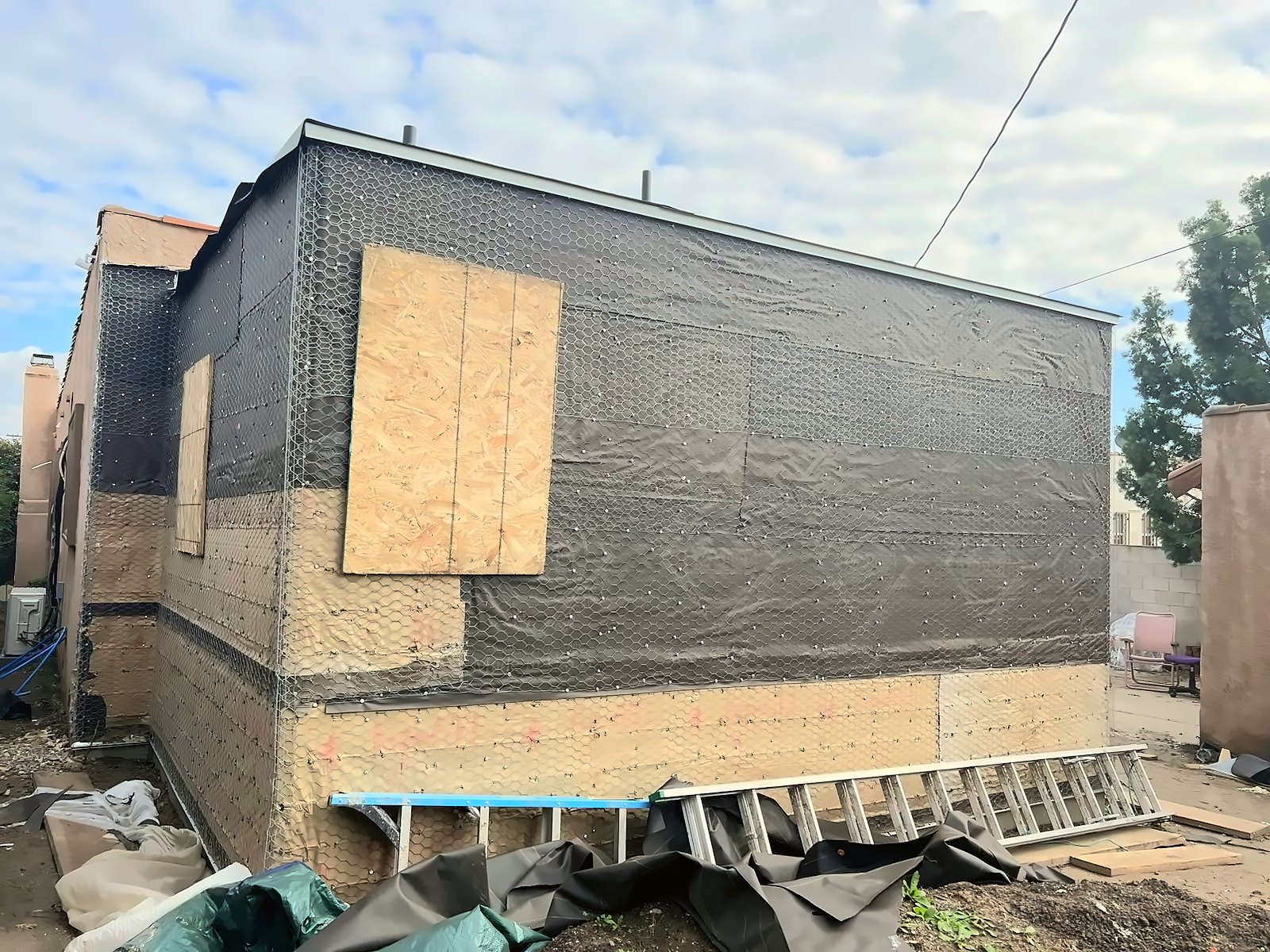
Stucco is not a coating; it is a layered cement plaster system. Section R703.7 of the 2025 California Residential Code requires exterior plaster to be installed in compliance with ASTM C926, the standard for applying portland cement-based plaster, and ASTM C1063, the standard for installing the lath it is applied to. From the framing out:
- Framing and sheathing. Many older houses have no sheathing — the paper and wire are stretched straight across the studs. Newer houses usually have plywood or OSB.
- Water-resistive barrier. The building paper. Section R703.7.3 sets its performance: in dry climate zones, two separately installed layers of 10-minute Grade D paper (or an equivalent), or a single 60-minute Grade D layer separated from the stucco by a drainage or other non-absorbing layer; in marine climate zones, an added drainage space of at least 3/16 inch. The paper is what keeps water out of the house; the stucco only sheds most of it.
- Lath. Corrosion-resistant expanded metal, welded wire or woven wire. Section R703.7.1 requires the nails or staples to be no more than 7 inches apart along each stud.
- Scratch and brown coats. Section R703.7.2 requires at least three coats of plaster over metal or wire lath. Over wire lath, Table R702.1(1) sets a minimum thickness of 7/8 inch for exterior cement plaster.
- Finish coat. The thin top coat that gives the wall its texture and, with a cementitious color coat, its color.
- Weep screed. A metal or plastic strip at or below the foundation plate line. Under Section R703.7.2.1 it must sit at least 4 inches above the earth or 2 inches above paved areas and let trapped water drain to the outside.
Two consequences matter for repair. The code sets curing intervals for three-coat work (Section R703.7.5) — at least 48 hours between the first and second coats and at least seven days before the finish coat — so a real re-stucco cannot be rushed. And everything that keeps water out is behind the plaster: a surface patch can make a wall look right while the paper behind it is still torn.
Reading stucco cracks: what is normal and what is not
Cement plaster shrinks as it cures and moves with temperature and with the framing behind it, so some cracking is normal on almost every stucco house. What matters is the pattern, the width and whether the crack is still moving. Where structure is in question, none of this replaces an engineer.
Hairline and map cracking
Fine cracks in a random, web-like pattern are usually shrinkage in the plaster itself. On a wall with sound paper behind it they are mainly cosmetic — the classic case for re-coating rather than patching crack by crack.
Diagonal cracks at window and door corners
Openings concentrate stress, so short diagonal cracks from the corners of windows and doors are common. A single, narrow, stable corner crack is a patch. One that keeps reopening, or comes with a door or window that has started to stick, points to movement a patch will not fix.
Wide, stepped or offset cracks
Cracks that catch a fingernail, cracks where one side sits proud of the other, long horizontal cracks, and cracks that line up with cracks in the slab or interior drywall should be investigated before anyone patches them. Our guide to the warning signs your foundation needs repair covers what to look for indoors, and our foundation repair cost guide explains the fixes. Patching over active movement just produces a neat new crack in the same place.
Cracks after an earthquake
New cracking after a quake is a reason to have the cripple walls and foundation connection looked at, not only the stucco. If the house has never been retrofitted, read about seismic retrofitting and the state’s Earthquake Brace + Bolt grant program before spending money on the surface.
Option 1: patching stucco properly
A good stucco patch is a small re-stucco, not a smear of filler. On anything bigger than a hairline crack:
- Cut back to sound stucco until the edges are hard and well bonded.
- Inspect what is exposed. If the paper is torn or the lath rusted or loose, the opening grows until it reaches sound paper and lath on every side, and new paper is lapped shingle-fashion with the old so water still drains outward and down.
- Rebuild in coats, with time to cure, not in one thick pass that shrinks and cracks.
- Match the texture — sand finish, lace, dash or smooth trowel — by hand, ideally on a test area first.
- Finish the whole panel, carrying the color to a natural break such as a corner or joint rather than dabbing it over the patch.
Step five is why so many patches show: fresh color over a patch rarely matches a wall that has had years of sun. Ready-mixed acrylic stucco patch is fine for hairline cracks and nail holes, but caulk smeared over cracks is not a repair — it collects dirt, will not hold texture and shows through paint.
Option 2: re-coating sound stucco
When the stucco is hard, bonded and dry but tired — faded, chalky, covered in fine cracks — re-coating gives the wall a new surface without tearing it off. The three common approaches behave differently:
| Compared on | Cementitious color coat | Exterior acrylic paint | Elastomeric coating |
|---|---|---|---|
| What it is | A new thin coat of cement-based finish plaster, color mixed in | A standard exterior paint system | A thick, flexible coating applied much heavier than paint |
| Hairline cracks | Filled as part of the new finish coat | Bridges very little; cracks tend to show through | Designed to span small cracks |
| Moisture | Cement-based, with no paint film on the surface | Varies by product; check the vapor permeability rating | Typically low vapor permeability; can hold moisture in the wall |
| Best for | Refreshing or re-texturing unpainted stucco | Sound walls with few cracks | Dry walls with widespread hairline cracking |
Elastomeric is often sold as the answer to cracked stucco, and on the right wall it is a good one. The Northwest Wall and Ceiling Bureau’s technical guidance on painting stucco notes that elastomeric coatings are typically very low in vapor permeability and can trap moisture trying to leave the wall, should not be used to solve a water-intrusion or flashing problem, and can be difficult to remove or re-color later. It recommends coatings for stucco with a perm rating of 7 or higher.
In practice: use elastomeric on a dry wall with lots of fine cracks, and never to cover a stain nobody has explained. For the painting side, see our exterior house painting cost guide and browse our exterior painting design ideas.
Option 3: a full re-stucco
A full re-stucco removes the old plaster, lath and paper down to the framing or sheathing and rebuilds the wall to the current code. It is the right call when:
- Large areas sound hollow or are coming away from the wall.
- Water has got behind the stucco and the paper has failed — staining, soft plaster, rot at the sill plate.
- The house has been patched so often that the walls no longer read as one surface.
- The walls are being opened anyway for new windows, an addition or a whole-home renovation.
- There is no working weep screed, and soil or paving has built up against the wall.
Some bids call a new layer of plaster over old stucco a “re-stucco”. Over sound, well-bonded stucco that is really a re-coat, and it can be the right job; over loose or wet stucco it only hides the problem. Ask every bidder which one they mean.
What happens during a re-stucco
- Protection and access — landscaping, windows and hardscape covered; scaffolding where the wall height needs it.
- Tear-off of stucco, lath and paper. On a pre-1978 house with painted stucco, this falls under the EPA’s Renovation, Repair and Painting rule: paid work that disturbs paint in pre-1978 housing must be done by certified firms, and while exterior jobs of 20 square feet or less are generally exempt, demolition of painted surfaces is covered regardless of size.
- Framing inspection and repair. The step that changes the scope: rot at sill plates, termite damage and wet sheathing are fixed before anything new goes on.
- Weep screed at the foundation line, with the code’s clearances.
- New paper, with windows and doors flashed and lapped into it.
- New lath, fastened to the framing.
- Scratch, brown and finish coats, with the required curing time between them.
- Inspections and cleanup.
If your windows are original or near the end of their life, a re-stucco is the best chance you will get to replace them: the wall is already open, and new window flanges can be flashed into new paper. Our window replacement cost guide explains the options, and our windows and doors page covers what we install.
Stucco repair cost: what actually drives the number
We do not publish a price range for stucco work, because a range wide enough to be honest would be too wide to be useful. Two houses with the same area of cracked stucco can end up in very different places depending on what is found behind the surface. These are the factors that move the number:
| Cost driver | Why it changes the price |
|---|---|
| Area and number of walls | More material and labor, and finishing whole panels for a color match adds area beyond the damage |
| Wall height and access | Two-story walls, hillside lots and tight side yards need scaffolding |
| What is behind the stucco | Rot, termite damage or failed sheathing must be repaired first, and cannot be priced until it is seen |
| Paper and lath | A surface repair keeps them; a section repair or re-stucco replaces them |
| Color and texture matching | Hand-matching an old texture is skilled work; an aged color rarely matches without re-coating the panel |
| Windows and flashing | Re-flashing or replacing windows adds scope now but avoids cutting into new stucco later |
| Permit, inspections and lead-safe work | A permit is required for re-stucco in the City of Los Angeles; painted pre-1978 houses need lead-safe containment |
The useful number is a written scope: which walls, which layers, what happens if rot is found, and how the finish will be matched. We price that after a site visit of about two hours and send a written proposal within 48 hours. If stucco is part of a larger project, our financing page explains how payment can be spread out.
Do you need a permit for stucco repair in Los Angeles?
In the City of Los Angeles it depends on the scope:
- Painting and re-coating. LAMC Section 91.106.2 lists painting, papering and similar work as exempt from permit.
- Small repairs. The same section exempts work valued at $2,500 or less, unless it affects structural stability or public safety, is done to comply with a Department order, or changes the use or occupancy. Our roof permit guide explains this exemption in more detail.
- Re-stucco. LADBS lists “re-stucco for residential buildings” in its Express Permits bulletin, P/GI 2020-003 — work that needs a permit but no plan check. The bulletin also lists replacing existing siding with new stucco on single-family dwellings and duplexes.
The inspections are what protect you: someone independent sees the paper, lath and screed before they disappear under plaster. Our guide to LADBS permit costs explains how fees are worked out. Outside the City of Los Angeles — Glendale, Burbank, Pasadena, unincorporated county areas, and the cities of Orange and Ventura counties — each building department sets its own rules.
Houses in fire hazard areas
For the 2025 code cycle, California moved its wildfire construction rules out of Section R337 of the Residential Code and into Title 24, Part 7, the California Wildland-Urban Interface Code. Its Section 504.5 limits exterior walls of the buildings it covers to listed methods, including noncombustible materials, one-hour fire-resistance-rated construction on the exterior side and tested assemblies. If your house is in a mapped fire hazard area, ask the building department how a re-stucco will be documented under Part 7 before work starts. We cover rebuilding after a wildfire on our fire rebuild page.
Mistakes that make stucco problems worse
- Burying the weep screed. Raised planters, new topsoil, pavers or a patio poured tight to the house hold water against the bottom of the wall. The code’s 4-inch clearance above soil and 2-inch clearance above paving exist so trapped water can get out.
- Sealing the screed shut with paint, caulk or mortar packed into the drainage gap.
- Patching without finding the water. A stain under a window is usually a flashing or runoff problem, and stains near the roofline often start at the roof edge — see our guide to roof leak repair, and check whether the roof is simply at the end of its life using how long a roof lasts in Southern California.
- Using elastomeric or caulk to stop a leak. Both hide the symptom and can trap the moisture behind it.
- Sprinklers aimed at the house. A wall soaked every morning stays wet at the base, and adjusting the heads costs nothing.
- Patching a moving crack again and again. If a crack returns, the problem is not the stucco.
Can you repair stucco yourself?
Yes, for small things: hairline cracks, nail and screw holes, and a small ding where the paper behind is intact. Call a professional when the stucco sounds hollow, when there is staining or softness, when cracks are wide or keep returning, when the damage is more than a small patch, or when the house was built before 1978 and the stucco is painted.
How to choose a stucco contractor
The Contractors State License Board licenses lath and plaster specialists under the C-35 Lathing and Plastering classification. Whoever you hire, check the license first — our guide on how to verify a contractor’s license in California takes a couple of minutes — and then ask:
- Will you open the wall around the damage, and how is the price handled if you find rot or torn paper?
- Does this need a permit, and who pulls it?
- How will you match the texture and color, and how far will the finish coat extend?
- Where will the weep screed end up relative to the soil and paving?
- If the house is pre-1978 and painted, is your firm RRP-certified?
- What does the warranty cover? Ours is set out on our warranty page.
Our questions to ask before hiring an exterior painter apply equally to the coating side of the job, and you can read what homeowners say about working with us on our reviews page — 4.7 stars across 146 Yelp reviews.
Stucco repair FAQs
How much does stucco repair cost?
There is no honest single number. Cost depends on the area, wall height and access, whether the paper and lath must be replaced, what is found behind the stucco, how color and texture are matched, and whether a permit is needed. A small patch and a whole-house re-stucco are different jobs, which is why we price stucco only after a site visit.
Can a stucco patch be made invisible?
Close to it, if the texture is matched by hand and the color is finished across the whole wall panel to a corner or joint. A patch colored on its own almost always shows, because the wall around it has faded.
Is elastomeric paint good for cracked stucco?
It works well on dry walls with widespread hairline cracking, because it is designed to span small cracks. Northwest Wall and Ceiling Bureau guidance notes that elastomeric coatings are typically low in vapor permeability, can trap moisture, should not be used to fix water intrusion, and can be hard to remove or re-color later.
How long does new stucco need to cure before painting?
The California Residential Code requires at least 48 hours between the first and second coats of three-coat stucco and at least seven days before the finish coat. For paint, Northwest Wall and Ceiling Bureau guidance is to wait until the surface pH drops to 8 or lower, which typically takes a week to 10 days; follow the coating manufacturer’s instructions too.
Do I need a permit to re-stucco my house in Los Angeles?
Yes, in the City of Los Angeles. LADBS lists re-stucco for residential buildings as an express permit, so no plan check is required. Painting is exempt, and repairs valued at $2,500 or less are exempt unless they affect structural stability or public safety. Other cities set their own rules.
How can I tell if a stucco crack is structural?
Fine, random hairline cracks are usually shrinkage. Cracks that catch a fingernail, cracks with one side offset, long horizontal or stair-stepped cracks, and cracks that keep reopening or line up with cracks indoors suggest movement and should be investigated before anyone patches them.
How long does a re-stucco take?
Longer than most people expect. The code’s curing intervals alone add more than a week between the first coat and the finish coat, before tear-off, framing repairs, paper and lath, inspections and weather. The schedule for a specific house comes with the written proposal.
Should I replace my windows when I re-stucco?
If the windows are near the end of their life, yes. The wall around them is already open, so new windows can be flashed properly into the new paper; replacing them later usually means cutting into fresh stucco.
Have your stucco looked at before you choose a fix
The right repair depends on what is behind the surface, and that is something we check in person. We tap the walls, open suspect areas where needed, look at the base of each wall and the water sources above it, and give you a written scope that says whether you need a patch, a re-coat or a re-stucco, and why. Site visits take about two hours, proposals follow within 48 hours, and we reply to every inquiry within one business day. Call (800) 348-3050, 8am–6pm daily, or request a stucco repair estimate.