Every contractor claim in California can be checked in a few minutes, and the order matters: start with the CSLB contractor license, which is the only credential the state actually requires; then verify any specialty certification the contractor advertises, whether that is a green building certification, a manufacturer installer program or a trade credential; and for homes built before 1978, confirm EPA Lead-Safe certification.
Marketing labels get used loosely. “Green certified”, “certified installer” and “master craftsman” are not government licenses, and homeowners in Los Angeles often assume they are. Below is how we verify each claim ourselves, step by step, before we would hire anyone who advertises this way.
Start With the California Contractor’s License
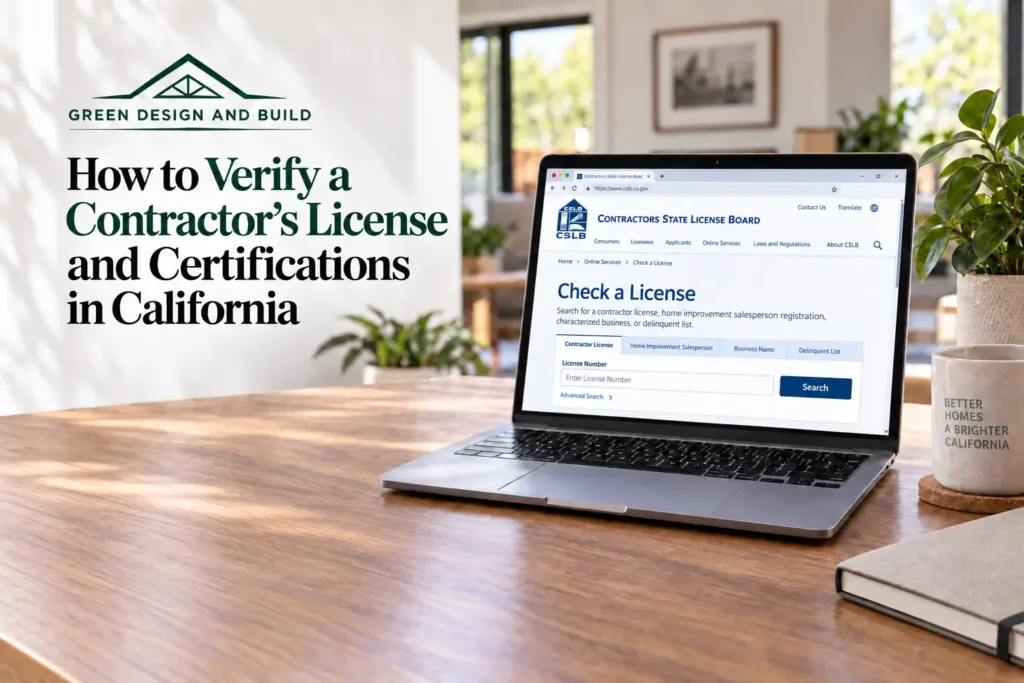
Before any green credential matters, the contractor needs to hold an active, appropriately classified license issued by the Contractors State License Board (CSLB). You can look up any license for free using the CSLB’s online license search tool.
What to Check on the License Record
The CSLB record will show the license status (active, expired, revoked, or suspended), the classification (a B classification covers general building contracting), the bond status, and any disciplinary actions on file. As of January 1, 2023, California requires licensed contractors to carry a $25,000 contractor’s bond, which exists to compensate homeowners for losses tied to defective work or license law violations. If the bond shows as missing or lapsed, that is a serious red flag on its own, unrelated to anything about “green” claims.
You can run this check on us right now: verify license #1110975 on the CSLB site.
Confirm Workers’ Compensation Insurance
The CSLB record also indicates whether a contractor carries workers’ compensation insurance, which is required in California for contractors with employees. A homeowner can be exposed to liability if an uninsured worker is injured on their property, so this is worth confirming independently rather than taking a contractor’s word for it.
Then Verify the Specific Green Certification Being Claimed
Once the license and bond check out, the next step is figuring out which green credential the contractor is actually referring to. A few show up most often in the Los Angeles market.
GreenPoint Rated
GreenPoint Rated is a California-specific residential green building rating program administered by Build It Green. It is one of the credentials most relevant to LA homeowners because it was built around California homes and California climate zones, covering categories like energy efficiency, indoor air quality, water conservation, and resource-efficient materials. Contractors and consultants who hold this credential are typically listed as certified GreenPoint Raters, and a homeowner can ask to see that certification directly rather than relying on a logo on a website.
LEED Accreditation
LEED (Leadership in Energy and Environmental Design), administered through the U.S. Green Building Council and Green Business Certification Inc., is more common on commercial and larger residential projects than on a typical single-family remodel. An individual can hold a LEED Green Associate or LEED AP credential, which reflects personal training rather than a project certification. If a contractor cites LEED, it is fair to ask whether they mean their own personal accreditation or that the finished project itself will pursue LEED certification, since those are two different things.
National Green Building Standard (NGBS)
NGBS is a green building framework aimed specifically at residential and multifamily construction, with certification tiers similar in concept to LEED’s. It is less commonly seen on smaller LA remodel projects but does appear on new home construction and larger multi-unit builds.
ENERGY STAR Partner
Being an ENERGY STAR partner relates primarily to installing ENERGY STAR-certified products and, for new construction, building to ENERGY STAR’s home certification requirements. It is a useful signal but a narrower one than a full green building rating.
For Older LA Homes, Ask About EPA Lead-Safe Certification
This one is not optional, and it is not really a “green” credential so much as a legal requirement. Under the EPA’s Renovation, Repair, and Painting (RRP) Rule, any firm paid to disturb paint in a home built before 1978 must be an EPA Lead-Safe Certified Firm, and the individuals performing that work must complete the required renovator training. A large share of the Los Angeles housing stock was built before 1978, so this applies more often than homeowners expect, particularly on older bungalows and mid-century homes in neighborhoods throughout the city. If your home falls into that category, ask directly whether the contractor and the firm are RRP-certified, and ask to see the certificate rather than taking a verbal yes.
Our whole-home renovation page explains how we handle EPA lead-safe practices on pre-1978 homes.
Ask for the Certificate, Not Just the Claim
A logo on a website or a truck wrap is not verification. Every credential described above comes with an actual certificate or a searchable record: a CSLB license number you can look up yourself, a GreenPoint Rater ID, a LEED credential ID searchable through the USGBC/GBCI credential directory, or an EPA Lead-Safe Certified Firm number. A contractor who is genuinely certified will not hesitate to provide these, because they are used to being asked.
| Credential | Issued by | What it tells you | How to check it |
|---|---|---|---|
| CSLB contractor license | Contractors State License Board | The only credential the state requires; a B classification covers general building | Look the number up on the CSLB site: status, classification, the $25,000 bond, disciplinary actions and workers’ compensation |
| GreenPoint Rated | Build It Green | A California residential green building rating | Ask for the GreenPoint Rater ID |
| LEED Green Associate or LEED AP | U.S. Green Building Council and GBCI | Personal training, not a certification of the project | Search the credential ID in the USGBC/GBCI credential directory |
| EPA Lead-Safe Certified Firm | U.S. EPA (Renovation, Repair and Painting Rule) | Required for any firm paid to disturb paint in a home built before 1978 | Ask for the EPA Lead-Safe Certified Firm number and certificate |
Questions Worth Asking Directly
It helps to ask a contractor plainly which certification they hold, who issued it, and whether it applies to them personally or to the project as a whole. It also helps to ask what specifically the certification changes about how they will build your project, whether that is the materials they source, the insulation and air-sealing approach, water fixtures, or waste diversion during demolition. A contractor who understands their own certification will be able to answer in specifics. One who cannot explain what the certification actually covers is worth treating with more caution, regardless of what claims appear in their marketing.
The Short Version
Verifying a green-certified general contractor in Los Angeles means confirming an active CSLB license and bond first, then independently checking whichever specific green credential is being claimed, such as GreenPoint Rated, LEED, or NGBS, and separately confirming EPA Lead-Safe Certified status if your home was built before 1978. None of these checks take more than a few minutes each, and a legitimate contractor will expect you to run them.
You can verify our license directly with the CSLB — #1110975 — and read more about Green Design and Build.
For the full checklist, read our guide to hiring a general contractor without getting scammed.
Sources
- CSLB, Check a License — where to look up a license number, its status and classification, and whether the bond and workers’ compensation coverage are current.
- U.S. EPA, Renovation, Repair and Painting Program for contractors — the federal rule for firms paid to disturb painted surfaces in homes built before 1978.
Want to check us before you call?
Our license is CSLB #1110975; look it up, then call us. The site visit and the itemized written estimate are free.