
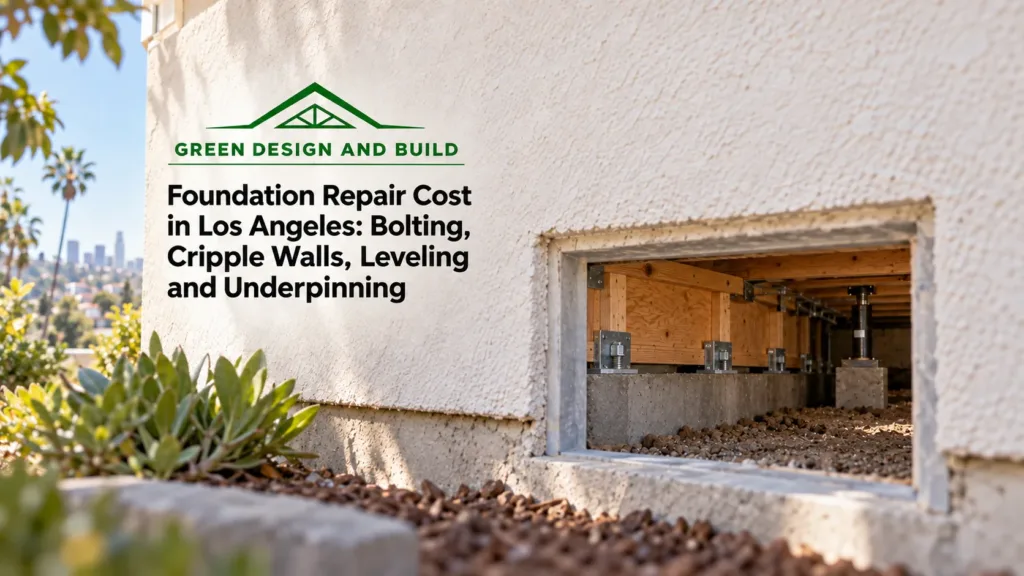
Foundation repair in Los Angeles typically costs from about $500 to inject a single stable crack to $30,000 to $100,000 or more to replace a foundation, with a bolt-and-brace seismic retrofit at $3,000 to $15,000, house leveling at $5,000 to $25,000 and pier underpinning at $10,000 to $40,000. Green Design and Build is a licensed, bonded and insured general contractor (CSLB #1110975) based in Van Nuys that repairs, levels, retrofits and replaces foundations for homeowners across Los Angeles County, Orange County, Ventura County, western Riverside County and western San Bernardino County (Ontario, Rancho Cucamonga and neighboring cities). These are typical Los Angeles budgeting estimates, not a price list or a quote. Your project can come in lower or higher depending on the house, the scope and the finishes; the only real number is a written proposal after a site visit.
We are led by Dekel Sofer; the company has completed hundreds of projects and holds a 4.7-star rating across 146 reviews on Yelp. Foundation work is often the first phase of a full home renovation or a second-story addition, and it is priced on what we find in the crawl space, not on a square-foot formula.
On this page
- Foundation repair cost by type of repair
- What each repair is, and when you need it
- Permits, standard plans and engineering
- Is a seismic retrofit required when I sell my house?
- Soils: hillside lots and expansive clay
- How long foundation repair takes
- How to compare foundation repair quotes
- Where we do this work
- Foundation repair cost FAQs
- Sources
- Get the diagnosis before the number
Foundation repair cost by type of repair
| Repair | What it is | Typical Los Angeles budgeting range | What drives the price |
|---|---|---|---|
| Bolt-and-brace seismic retrofit (house bolting) | New anchor bolts or foundation plates through the sill plate into the stem wall, plus structural plywood on the cripple walls | $3,000–$15,000 | Perimeter length, crawl-space access, existing bolts, whether an engineered design is needed |
| Crack injection | Epoxy or polyurethane injected under pressure into a stable crack in a stem wall or slab | $500–$3,000 per area | Crack width, number of cracks, whether movement is ongoing |
| Drainage correction | Regrading, downspout extensions, French drain, sometimes a sump | $3,000–$15,000 | Length of drain, hardscape cut and replaced |
| House leveling and pier-and-beam repair | Jacking a settled raised floor and replacing posts, pads, girders and shims | $5,000–$25,000 | How far the floor has dropped, how many posts and girders are replaced |
| Underpinning | Concrete or steel piers beside and beneath the footing, carrying it to competent soil | $10,000–$40,000 | Number of piers, depth to competent soil, engineering and soils report |
| Partial or full foundation replacement | House carried on cribbing while a new reinforced footing and stem wall are poured | $30,000–$100,000+ | Linear feet replaced, whether the house is lifted, hillside access |
These are typical Los Angeles budgeting estimates, not a price list or a quote. Your project can come in lower or higher depending on the house, the scope and the finishes; the only real number is a written proposal after a site visit. The figures include labor, materials and the permit. A new foundation for a room addition or an ADU is priced inside that project rather than as a repair; our second-story addition cost and whole-home renovation cost guides show where foundation work sits in those budgets.
What each repair is, and when you need it
House bolting and cripple-wall bracing (seismic retrofit)
If your house was built before 1980 on a raised foundation, there is a good chance it is not bolted to its concrete, or bolted every eight to twelve feet, and that the short cripple walls between the foundation and the floor are unbraced. In an earthquake an unbolted house can slide off its foundation and an unbraced cripple wall can collapse, both of which were documented across the San Fernando Valley in the 1994 Northridge earthquake. A retrofit ties the sill plate to the stem wall with new bolts or plates and square washers, nails structural plywood to the cripple walls so they act as shear walls, and connects the floor framing to the cripple wall so the load path is continuous from the roof to the concrete. Our seismic retrofit page goes through what a given house actually needs and whether it fits the standard plan.
At $3,000 to $15,000 it is the most cost-effective structural work a Valley or Los Angeles homeowner can buy, and it is two to five days of work once the permit is issued.
Crack injection
Stable cracks in a stem wall or a slab are sealed with epoxy (structural) or polyurethane (flexible, for water). The injection itself is inexpensive; the judgment is in deciding whether the crack has stopped moving. A crack that is still opening gets injected only after the cause, usually drainage or a leaking under-slab pipe, is fixed, or it will reopen beside the repair.
Drainage correction
More Southern California foundation problems start with water than with earthquakes. Downspouts that dump against the stem wall, planters against the house, and lots that slope toward the foundation saturate the soil on one side, and the foundation moves with it. Regrading, extending downspouts and installing a French drain along the affected wall is often the cheapest repair on this page and sometimes the only one needed. Our post on warning signs your foundation needs repair describes a house where small cracks around interior doors and one door that would not close were left alone until several doors stuck and the floors went uneven; the cause turned out to be soil movement under part of the foundation from poor drainage and water collecting too close to the house, and an early drainage fix would have prevented most of it.
House leveling and pier-and-beam repair
A raised-foundation house settles when its posts sink, its pads crack or its girders sag between posts set too far apart. Leveling means jacking the floor slowly, as much as twelve inches in a badly dropped house, then replacing posts and pads, sistering or replacing girders and joists, and lowering the house onto the new supports. Lifting a house moves everything attached to it: doors and windows bind and plaster cracks open, so our leveling scope includes re-hanging doors and patching, priming and painting the cracks inside and out. A quote that stops at the structure leaves you with a level house full of cracked walls.
Underpinning with piers
When the soil under one part of the house cannot carry the load, because of fill, saturated clay or a washed-out void under a slab, the footing is underpinned: concrete or steel piers are installed beside and beneath it, driven or drilled to competent soil, and the footing is lifted and locked to them. This is engineered work built on a geotechnical report, which is why it starts at $10,000 and runs to $40,000, and why the number of piers matters more than the size of the house.
Foundation replacement
Unreinforced concrete from the 1920s to 1940s, brick foundations, and stem walls rotated out of plumb are replaced in sections. The house is carried on temporary cribbing while a new reinforced footing and stem wall are poured with anchor bolts set in the fresh concrete. At $30,000 to $100,000 or more it is the largest number on this page, and on a hillside lot with poor access it is the one most likely to exceed the range.
Permits, standard plans and engineering
Every repair above except crack injection and simple drainage work needs a building permit, because it alters the structure that carries the house.
- City of Los Angeles (LADBS). For Van Nuys, Sherman Oaks, Encino, Studio City, Woodland Hills, Northridge, North Hollywood and the rest of the city, a bolt-and-brace retrofit that follows LA City Standard Plan No. 1 is an express permit with no plan check: LADBS Information Bulletin P/GI 2020-003 lists “add sill plate anchor bolts and plywood to cripple walls (if existing) per LA City Standard Plan #1” for houses and residential buildings up to three stories and four units, with a second express item that adds foundation replacement. The standard plan covers raised-floor houses with cripple walls no taller than 48 inches, and in most retrofits without foundation replacement only one inspection is required, after the work is done. Houses outside the plan, with tall cripple walls, post-and-pier or brick foundations, or on hillside lots, need an engineered design and plan check.
- Other cities and the counties. Burbank, Glendale, Pasadena, Santa Clarita, Long Beach, every Orange County city, the Ventura County cities, and Corona, Riverside, Ontario and Rancho Cucamonga run their own building divisions and generally accept retrofits designed to Chapter A3 of the California Existing Building Code, the state’s prescriptive standard for cripple walls up to four feet.
- Engineering and soils. Underpinning, replacement and leveling that changes the load path need an engineer’s drawings or letter. A soils report is required in the City of Los Angeles when the lot is on a hillside or when the building department flags slope stability, liquefaction or expansive soil, and the LADBS Grading Division approves the report before foundation plan check proceeds; the same applies in the foothill cities and on graded lots in Riverside and San Bernardino counties.
Is a seismic retrofit required when I sell my house?
No. California does not require a seller or a buyer to retrofit a house. What the law requires, for houses built before 1960 with conventional wood framing, is that the seller deliver the state’s Homeowner’s Guide to Earthquake Safety and a Residential Earthquake Hazards Report disclosing whether the water heater is braced, whether the house is bolted, whether the cripple walls are braced and whether the lot is in a mapped fault or seismic hazard zone. The guide says it plainly: “State law does not require either the seller or buyer to strengthen a home against earthquake risks.” A retrofit can still be a condition negotiated between buyer and seller, and an unbolted house is a common inspection finding that becomes a credit or a repair request, but it is a negotiation, not a legal requirement.
If the inspection finds an unbolted house, a state grant may pay for a large part of fixing it. See our guide to the Earthquake Brace + Bolt grant for the eligibility rules and what the retrofit costs after the grant.
Soils: hillside lots and expansive clay
Where the house sits decides which repair it needs.
Hillside lots. Houses in the Hollywood Hills, the hills of Sherman Oaks, Encino, Studio City and Woodland Hills, the foothills of Glendale and Pasadena and the canyons of Orange and Ventura counties sit on cut-and-fill pads, stepped footings or caissons and grade beams. Poorly compacted fill and creep on steep descending slopes are the problems we see most, and both are underpinning or replacement jobs with a geotechnical report first. Los Angeles Municipal Code section 91.7006 lets LADBS require an engineering geology and soils report whenever slope stability or liquefaction is a concern or the foundation does not meet the code’s default design, and on a hillside lot it always is.
Expansive clay. Much of western Riverside County, including Corona, Eastvale, Norco and Jurupa Valley, western San Bernardino County, and parts of the Santa Clarita Valley sit on clay soils that swell when wet and shrink when dry. A slab on that soil lifts at the edges after winter rain and drops in late summer; the house shows it as doors that stick seasonally and cracks that open and close. Riverside County Building and Safety requires a soils investigation on graded lots and an engineer’s foundation design verification when the soil proves expansive, and Los Angeles County’s residential code manual calls for deeper footings, extra reinforcing and a reinforced slab over sand and a vapor barrier on expansive lots. For an existing house the remedy is usually moisture management (steady irrigation, drainage away from the slab) plus crack repair, with underpinning where a corner has moved beyond what the framing can tolerate. Chasing seasonal cracks with injection alone, without fixing the water, is the most common wasted money we see in the Inland Empire.
How long foundation repair takes
| Repair | Permit and engineering | Construction |
|---|---|---|
| Bolt-and-brace seismic retrofit | 1–3 weeks (LADBS express permit when the house fits Standard Plan No. 1; longer with engineering) | 2–5 days |
| Crack injection and drainage | Usually no permit for injection; grading and drains may need one | 1–5 days |
| House leveling | 2–4 weeks with an engineer’s letter or plans | 1–2 weeks |
| Underpinning | 4–8 weeks (soils report plus engineered design) | 1–3 weeks |
| Foundation replacement | 6–12 weeks (soils report, engineering, plan check) | 3–8 weeks |
How to compare foundation repair quotes
Foundation quotes vary more than almost any other trade because the same symptoms can be diagnosed three different ways. Before you compare numbers, make sure each quote states the diagnosis (settlement, heave, drainage, or inadequate support), the method and count (how many bolts and at what spacing, how many sheets of plywood, how many piers and to what depth, how many posts and girders), whether an engineer’s design or soils report is included, whether the permit and inspections are included, and who is responsible for the finish repairs after a lift. A bolting quote should reference LA City Standard Plan No. 1 or Chapter A3; an underpinning quote without a soils report is a guess. Verify the license on the CSLB website; foundation work is done under a B general building license or a C-8 concrete license, and the down payment on a home improvement contract cannot exceed $1,000 or 10 percent of the price, whichever is less.
Where we do this work
From our Van Nuys office we repair and retrofit foundations across the San Fernando Valley and the rest of Los Angeles County, where pre-1980 raised foundations make bolting and leveling the most common calls and hillside lots bring in the Grading Division; in Orange County, where slab-on-grade tract houses crack over under-slab plumbing leaks and drainage problems and master-planned communities add HOA review for exterior drainage changes; in Ventura County, which mixes older raised-foundation homes in Ventura and Oxnard with hillside lots in Thousand Oaks and Simi Valley; and in western Riverside County and western San Bernardino County, where newer slabs on expansive clay call for moisture management and, occasionally, underpinning. Our foundation page describes each service; see every city we serve on our service areas page.
Related cost guides: Sewer line replacement cost · Roof replacement cost · Electrical panel upgrade cost. If you plan to finance the work, our financing page explains the programs we offer and how progress payments work under California law.
Foundation repair cost FAQs
How much does foundation repair cost in Los Angeles?
Foundation repair in Los Angeles typically runs from about $500 for injecting a single stable crack to $30,000 to $100,000 or more for replacing a foundation, with drainage correction at $3,000 to $15,000, house leveling at $5,000 to $25,000 and pier underpinning at $10,000 to $40,000. These are typical Los Angeles budgeting estimates, not a price list; the biggest variables are how far the house has moved, crawl-space access and whether engineering and a soils report are required.
How much does house bolting cost in Los Angeles?
A bolt-and-brace seismic retrofit on a standard pre-1980 raised-foundation house in Los Angeles typically costs $3,000 to $7,000, or $7,000 to $15,000 for a larger house or difficult access, including anchor bolts or foundation plates, plywood on the cripple walls, the framing connectors and the permit. Perimeter length, crawl-space access and whether the house fits LA City Standard Plan No. 1 or needs an engineered design move it within that range, and construction takes two to five days.
Do I need a permit for foundation repair in Los Angeles?
Yes for any work that alters the structure carrying the house: bolting and bracing, leveling, underpinning and replacement all need a building permit in every city and county we serve. In the City of Los Angeles a retrofit that follows LA City Standard Plan No. 1 is an express permit without plan check; underpinning, replacement and hillside work go through plan check with engineered drawings. Crack injection and simple drainage work usually do not need a permit.
Is a seismic retrofit required to sell a house in California?
No. California law does not require a seller or buyer to retrofit a house against earthquakes. For homes built before 1960, the seller must deliver the Homeowner’s Guide to Earthquake Safety and a Residential Earthquake Hazards Report disclosing whether the house is bolted and its cripple walls braced, but the disclosure is the only obligation; any retrofit is negotiated between the parties.
Does foundation repair need a soils report or an engineer?
A bolt-and-brace retrofit that fits the city’s standard plan, crack injection, drainage work and most leveling on a flat lot do not need a soils report. Underpinning and foundation replacement are engineered from a geotechnical report, and any foundation work on a hillside lot, or where the building department flags liquefaction, slope stability or expansive soil, requires one. The report adds a few weeks and an engineering fee and its bearing values drive the design.
Will fixing the foundation fix the cracks in my walls?
A foundation repair stops the movement that caused the cracks but does not close them, and lifting a settled house can open new ones as the framing returns to level. That is why our leveling and underpinning scopes include re-hanging doors and windows and patching, priming and painting cracks inside and out. Ask any contractor whose quote stops at the structural work who is responsible for the finish repairs and what they will cost.
Sources
Permit and engineering requirements on this page are City of Los Angeles rules and the California Building Code; the price ranges are our own, from foundation work we have done, and every house is different. Confirm current requirements with your building department.
- California Building Standards Commission, Title 24 codes — the official index to Title 24, including Part 2 (Building Code), Part 3 (Electrical) and Part 6 (Energy). The 2025 edition took effect 1 January 2026.
- LADBS, Building Permits — the work that requires a permit in the City of Los Angeles, and the rule that building plans must be approved as a Building Plan Check before a permit is issued.
- CSLB Industry Bulletin, Progress Payment Restrictions — a down payment on a home improvement contract “may not exceed $1,000 or 10 percent of the contract price, whichever is less” (Business and Professions Code sections 7159 and 7159.5).
Last reviewed 17 September 2026.
Get the diagnosis before the number
We crawl the sub-area, photograph the posts, bolts and cracks, and tell you whether you are looking at a drainage fix, a bolting job, a leveling job or an underpinning job before we write a number down. The inspection and the written estimate are free.