
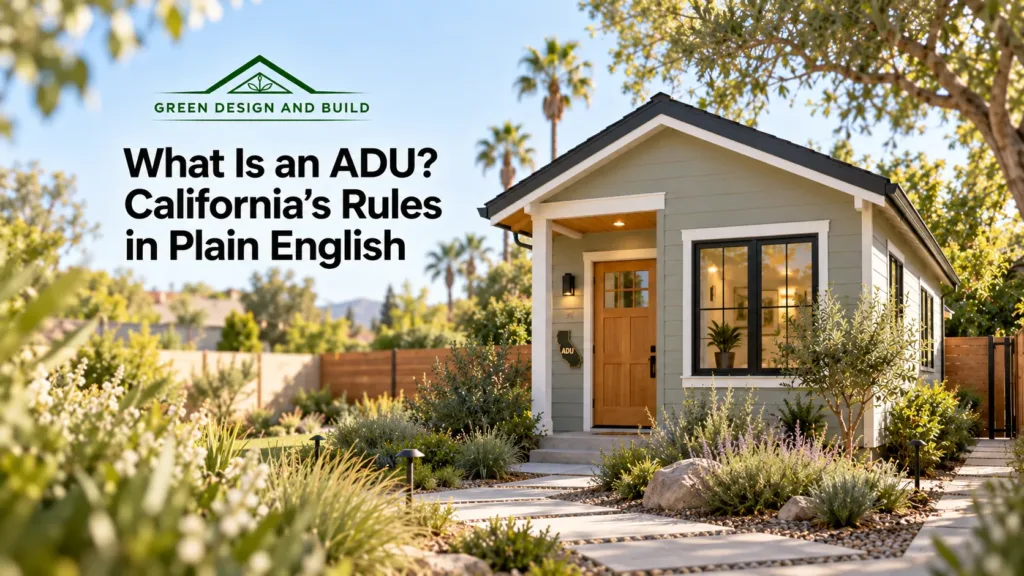
An accessory dwelling unit is a second, complete home on a lot that already has a house on it. California law defines it as a unit with permanent provisions for living, sleeping, eating, cooking and sanitation — and that word “cooking” is the whole test. A structure with a bedroom and a bathroom but no kitchen is not an ADU. Add a kitchen and it is. Everything else people argue about, including whether to call it a granny flat, a casita or a mother-in-law suite, is vocabulary rather than law. Green Design and Build is a licensed general contractor (CSLB #1110975) based in Van Nuys that designs, permits and builds ADUs across Los Angeles County, Orange County, Ventura County, western Riverside County and western San Bernardino County.
We are led by Dekel Sofer, who has more than 16 years of hands-on construction experience; the company has completed hundreds of projects and holds a 4.7-star rating across 146 reviews on Yelp. The state rules below apply everywhere in California. The Los Angeles specifics are called out separately, because the local half of this varies by city.
On this page
- The legal definition, and the one word that decides it
- Every other name for an ADU
- The four kinds of ADU
- What a junior ADU actually is
- How small can an ADU be?
- How big can an ADU be?
- How many can you have on one lot?
- A guest house is not an ADU, and in Los Angeles it has its own rules
- Movable tiny houses
- What if there is already a unit back there?
- The kitchen, in practice
- How common are ADUs now?
- What it costs and how long it takes
- Where we build ADUs
- ADU FAQs
- Find out what your lot actually allows
The legal definition, and the one word that decides it
Under Government Code section 66313, an accessory dwelling unit is an attached or detached residential dwelling unit that provides complete independent living facilities for one or more people, on a lot with an existing or proposed primary residence. It must include permanent provisions for five things: living, sleeping, eating, cooking and sanitation. An efficiency unit and a manufactured home both count.
Four of those five are easy. The fifth is the line everything turns on. The City of Los Angeles makes it even blunter in its own zoning code, which defines a dwelling unit as a group of two or more rooms, one of which is a kitchen, designed for occupancy by one family. No kitchen, no dwelling unit. That single distinction decides whether your project is an ADU with state protection behind it, or an accessory building with none.
Every other name for an ADU
Most people searching for this do not use the letters A-D-U. They use a word they grew up with. None of the terms below is defined anywhere in California statute or in the Los Angeles Municipal Code; the state’s own housing department acknowledges as much, noting that ADUs “have been known by many names: granny flats, in-law units, backyard cottages, secondary units and more.”
| What people call it | Legal status in California | What it usually means in practice |
|---|---|---|
| Granny flat | Colloquial | Any ADU, usually detached, often built for a parent |
| Mother-in-law suite / in-law suite | Colloquial | Usually an attached ADU or a junior ADU inside the house |
| Casita | Colloquial | A small detached unit, often Spanish or Mediterranean in style |
| Backyard cottage | Colloquial | A detached ADU |
| Secondary suite / secondary unit | Colloquial | An ADU. “Second unit” was California’s old statutory term |
| Carriage house | Colloquial | An ADU above or inside a detached garage |
| Guest house | Not an ADU | No kitchen. In Los Angeles this is a separate zoning category with its own rules — see below |
| Junior ADU (JADU) | Defined in statute | Up to 500 sq ft, inside the walls of the existing house |
| Movable tiny house | Defined by the City of Los Angeles | A DMV-registered unit on wheels, 150 to 430 sq ft |
The practical consequence is simple: if you ask a building department for a granny flat, nobody will know what standard to apply to you. Ask for an accessory dwelling unit and a specific, generous body of state law attaches to your application.
The four kinds of ADU
| Type | Where it goes | Worth knowing |
|---|---|---|
| Detached, new construction | A new structure in the yard | Cities must allow at least 800 sq ft with four-foot side and rear setbacks |
| Attached | Built onto the existing house | Shares a wall; height is tied to the main house |
| Conversion | Inside existing space — a garage, a basement, part of the house | No new setback required, and up to 150 sq ft of expansion is allowed purely for entry and exit |
| Junior ADU (JADU) | Within the walls of the single-family house, including an attached garage | 500 sq ft maximum, and its own rulebook |
Our guides compare a detached ADU against a garage conversion and weigh an ADU against a room addition if you are deciding between them.
What a junior ADU actually is
A JADU is no more than 500 square feet of interior livable space, contained entirely within the walls of a single-family residence. It is the cheapest way into an ADU because you are not building a structure, and it is the most misunderstood. The rules:
- One JADU per residential lot.
- It needs its own exterior entrance, separate from the main entrance to the house.
- It needs an efficiency kitchen: a cooking facility with appliances, plus a food preparation counter and storage cabinets sized reasonably for the unit. Notably, the state housing department has said cities may not dictate counter or cabinet sizes, specific electrical or gas connections, or appliance types.
- Sanitation can be shared with the house or separate.
- A deed restriction is recorded, prohibiting sale of the JADU separately from the house.
- Rentals must be longer than 30 days, so no short-term letting.
- Owner-occupancy changed on 1 January 2026. Under AB 1154, it is now required only where the JADU shares sanitation facilities with the house. Give the JADU its own bathroom and the owner-occupancy requirement falls away. Local ordinances written before 2026 may still show the old blanket rule; state law governs.
Our junior ADU cost guide covers what one costs to build.
How small can an ADU be?
Smaller than most people expect. California’s Health and Safety Code allows an efficiency unit with a minimum floor area of 150 square feet for occupancy by up to two people, and state ADU law separately forbids a city from setting a minimum ADU size that would prohibit an efficiency unit. So a 150-square-foot ADU is legal in principle anywhere in California.
You may also see 190 square feet quoted as the minimum. That number is real, but it is not an ADU minimum: it is the living-room size for an “efficiency dwelling unit” in California Building Code section 1208.4, which was 220 square feet until the 2022 code reduced it to 190. State ADU law points instead to the Health and Safety Code efficiency unit of 150 square feet and bars a city from setting an ADU minimum that would prohibit one. Ask your building department which figure it applies.
Separately, the Residential Code sets habitability floors that apply to any room: habitable rooms other than kitchens must be at least 70 square feet and at least 7 feet in any horizontal direction, with ceilings at least 7 feet high, or 6 feet 8 inches in a bathroom or laundry.
How big can an ADU be?
There is no statewide maximum. State ADU law sets floors that every city ordinance has to clear and then leaves the ceiling to the city. Under Government Code section 66321, a local agency may set minimum and maximum ADU sizes, but it may not adopt:
- a maximum below 850 square feet of interior livable space;
- a maximum below 1,000 square feet for an ADU with more than one bedroom; or
- any lot coverage, floor area ratio, open space, front setback or minimum lot size rule that stops you building an ADU of at least 800 square feet with four-foot side and rear setbacks.
The 1,200 square feet quoted on most ADU websites comes from the state’s standard for a detached ADU (Gov. Code 66314(d)(5)), which each city then writes into its own ordinance. The City of Los Angeles allows a detached ADU up to 1,200 square feet where the lot’s own standards allow it, and many Southern California cities settled on the same number — but a city may adopt a more permissive ordinance and allow a larger unit. The only way to know your ceiling is to read the ordinance for your address; our Los Angeles ADU rules by city page is the starting point.
Bigger is not automatically better. Impact fees cannot be charged on an ADU of 750 square feet or less, and above that they have to be proportionate to the primary dwelling, so crossing 750 square feet changes the fee picture as well as the build cost. Our ADU cost guide covers where the money actually goes.
Want a real number for your project?
The site visit and the itemized written estimate are free.
How many can you have on one lot?
On a single-family lot, three, as a floor rather than a ceiling. State law requires cities to ministerially approve a combination of: one ADU created within existing space, one junior ADU, and one newly constructed detached ADU. That is three additional units alongside the primary residence, and the state housing department’s own handbook states it in those terms. A city may allow more under its own ordinance; it may not allow fewer.
ADUs also do not count against your lot’s allowable density. Government Code section 66319 says an ADU is an accessory use that “shall not be considered to exceed the allowable density for the lot.” Do not over-read that, though: ADUs are still counted as housing units in the state’s regional housing reporting. It means your zoning does not block them, not that they are invisible.
A guest house is not an ADU, and in Los Angeles it has its own rules
This is where most published advice goes wrong, and it matters, because “can I just build a guest house instead” is one of the most common questions we get.
First, the Los Angeles Municipal Code does define “Guest House” — but not the way you think. In the LAMC a Guest House is a dwelling containing not more than five guest rooms or suites of rooms with no kitchen facilities. That is a lodging definition. The backyard building homeowners mean is a different defined term: Accessory Living Quarters, which the code describes as an accessory building used solely as the temporary dwelling of guests of the occupants, having no kitchen facilities and not rented or otherwise used as a separate dwelling unit.
You can still build one in Los Angeles. The catch is in the zoning: in the R1 zone, accessory living quarters may not be located on a lot having an area of less than 10,000 square feet (other residential zones set their own thresholds). Most Valley and South Bay lots are well under that. And unlike an ADU, an accessory living quarters gets no state protection at all — no guaranteed four-foot setbacks, no ministerial approval, no minimum size the city must allow. You are entirely in the hands of local zoning.
What counts as a “kitchen” for this purpose is more expansive than a stove. The City’s zoning interpretation manual has historically treated a natural gas outlet, a 220-volt outlet, a double sink, a bar sink over one square foot, a hot water line to a bar sink, a refrigerator over 10 cubic feet, a garbage disposal, a dishwasher or the space for one, any device designed for cooking or heating food, and more than 10 square feet of counter as kitchen facilities. That is interpretive guidance rather than code text, and it dates from an older edition of the manual, so confirm the current position with the department — but it tells you how carefully this line is policed.
And if you build a kitchen-less guest room and quietly add a kitchen later? It stops meeting the accessory living quarters definition and becomes an unpermitted dwelling unit. That is a code enforcement problem, not an upgrade. The lawful route is to permit it as an ADU from the start — which, given the state protections an ADU carries and the 10,000-square-foot lot rule a guest house does not escape, is usually the easier path anyway.
Movable tiny houses
The City of Los Angeles recognizes a category most cities do not. A Movable Tiny House is registered with the DMV, meets ANSI 119.5 or NFPA 1192 standards, cannot move under its own power, and measures between 150 and 430 square feet. In Los Angeles it can serve as an ADU. Treat this as a City of Los Angeles answer only: other jurisdictions handle tiny houses on wheels very differently and many do not accept them as ADUs at all.
What if there is already a unit back there?
Two different pathways, and they get blurred constantly.
A lawfully permitted structure with no kitchen — a guest room, a rec room, a garage — converts under the state’s conversion provision. The city must approve it ministerially, and you are allowed up to 150 square feet of expansion beyond the existing footprint purely to create entry and exit. The work is adding a compliant kitchen and bringing the building up to habitability standards.
An unpermitted unit someone has been living in is a different statute. Government Code section 66311.7 (which you may see cited by its old number, 66332) lets you legalize a unit built before 1 January 2020. The city cannot deny the permit for building-standard violations or for failing to meet the local ADU ordinance, and cannot charge impact fees. Los Angeles implements it through a documented process with a health-and-safety checklist, and the unit may comply either with current codes or with the codes in effect when it was built. You will need to evidence the construction date — utility bills, leases, contractor receipts.
The kitchen, in practice


This Los Angeles project is a garage conversion: the same footprint, a new kitchen with full appliances, a bathroom, and French doors where the garage door used to be. Once that kitchen went in, the building stopped being a garage and became a dwelling unit, with everything that follows from it. The full sequence is on the garage-to-ADU conversion project page.
How common are ADUs now?
Common enough to have changed what California builds. According to the state housing department’s March 2026 ADU handbook, ADUs permitted annually across California grew from 1,336 in 2016 to 30,354 in 2024, and in 2024 they made up more than 26.6 percent of all homes permitted statewide. Those are permits rather than finished buildings, so treat them as a measure of intent as much as output — but better than one in four homes permitted in California being an ADU is a genuine shift, and it is why the law keeps moving in their favor.
What it costs and how long it takes
Covered properly in their own guides rather than summarized badly here: what an ADU costs to build, what a garage conversion costs, how long an ADU takes, and how homeowners pay for them. If quotes you have received vary wildly, there are specific reasons for that.
For what your particular lot allows, we publish ADU rules by city across Southern California, an ADU rules calculator, and a guide to the LADBS standard plan program, which is the shortcut most homeowners miss.
Where we build ADUs
We build ADUs from our Van Nuys office across the San Fernando Valley, the rest of Los Angeles County, Orange County, Ventura County, western Riverside County and western San Bernardino County. The mix changes by area: garage conversions dominate in the older Valley neighborhoods where detached garages sit at the back of the lot, detached new construction is more common on the wider lots of the Inland Empire and outer Orange County, and junior ADUs make the most sense in larger houses where a wing can be separated off. See our ADU construction service and all of our service areas.
ADU FAQs
What is an ADU?
An accessory dwelling unit is a second, self-contained home on a lot with an existing or proposed primary residence. California law requires it to have permanent provisions for living, sleeping, eating, cooking and sanitation. In practice the kitchen is the defining feature: a structure with a bedroom and bathroom but no kitchen is not an ADU. It can be detached, attached to the house, or created inside existing space such as a garage.
Is a granny flat the same as an ADU?
Yes. “Granny flat” is a colloquial term with no definition in California statute or in the Los Angeles Municipal Code. So are mother-in-law suite, in-law suite, casita, backyard cottage, secondary suite and carriage house. The state housing department itself notes ADUs have been known by many names. Use “accessory dwelling unit” when you apply for a permit, because that is the term the law attaches to.
What is the difference between an ADU and a guest house?
A kitchen. An ADU has one; a guest house does not, and without one it is not a dwelling unit. In Los Angeles the backyard version is formally called accessory living quarters, and it may not be built on a lot smaller than 10,000 square feet in the R1 zone. A guest house also gets none of the state protections an ADU receives, such as guaranteed four-foot setbacks and ministerial approval, so on most lots the ADU route is both easier and more useful.
What is a junior ADU?
A JADU is up to 500 square feet of interior livable space created entirely within the walls of a single-family house, including an attached garage. It needs its own exterior entrance and an efficiency kitchen with a cooking facility, appliances, a food preparation counter and storage. Sanitation may be shared or separate, and a deed restriction is recorded against the property. Since 1 January 2026, owner-occupancy is required only where the JADU shares a bathroom with the house.
How many ADUs can I build on my property?
On a single-family lot, state law requires cities to allow a combination of one ADU created within existing space, one junior ADU, and one newly built detached ADU — three additional units alongside the house. That is a minimum, not a maximum; a city may permit more. ADUs also do not count toward your lot’s allowable density.
How small can an ADU be?
California allows an efficiency unit with a minimum floor area of 150 square feet for up to two occupants, and a city may not set an ADU minimum size that would prohibit one. Habitability rules still apply: habitable rooms other than kitchens must be at least 70 square feet and 7 feet in any horizontal direction, with 7-foot ceilings. The 190 square feet often quoted online comes from the Building Code’s efficiency dwelling unit section (CBC 1208.4), not from ADU law.
Can I rent out an ADU?
Yes, for terms longer than 30 days. Cities may require, and in practice nearly always do require, a minimum 30-day rental term, which rules out short-term letting. A JADU carries the same 30-day floor. An ADU generally cannot be sold separately from the main house, though a small number of California cities have opted into a condominium pathway that allows it.
Can I legalize an unpermitted unit in my backyard?
Often, yes, if it was built before 1 January 2020. Government Code section 66311.7 requires cities to permit qualifying unpermitted ADUs and junior ADUs without denying them for building-standard violations or for failing the local ADU ordinance, and without charging impact fees. The unit may comply with either current codes or the codes in effect when it was built, and a health-and-safety review applies. You will need documentation of the construction date.
Find out what your lot actually allows
We will look at the lot, the setbacks, the existing structures and your city’s current ordinance, and tell you which of the three routes — conversion, junior ADU or new detached unit — makes sense on your property before anyone draws anything. The site visit takes about two hours, the written proposal follows within 48 hours, and both are free. We reply within one business day.