
Roof Design Ideas
A roof is the largest single surface anyone sees from the street, and roofing is usually chosen under time pressure, from a brochure, at the point when the old one has already failed. These are the decisions worth making deliberately.
Green Design and Build (CSLB #1110975) is a general contractor based in Van Nuys; roof replacement and repair is performed and permitted under a C-39 Roofing license, by a roofing contractor scheduled and supervised by us. On a 1,500 to 2,000 sq ft single-story Los Angeles house a composition shingle replacement typically costs $12,000 to $25,000, and clay tile or standing-seam metal $30,000 to $65,000. For materials, cost and the permit path, see roofing and roof replacement cost.
Two practical points before the design questions. If you are here because of water coming in, start with roof leak repair — many leaks are a failed detail rather than a finished roof. If you are trying to work out whether yours is due, how long a roof lasts in Southern California sets out realistic service life by material.
Color, and the two things nobody accounts for
First: a roof sample is seen flat, in your hand, from two feet away. The roof is seen at an angle, from the street, in full sun, across a large area. Color reads lighter and more uniform at distance than it does in the sample. Look at real roofs in the neighborhood in the material you are considering, not at swatches.
Second: the roof has to work with things you are not replacing — the stucco or siding color, the window frames, the stone or brick, the driveway. A roof chosen in isolation is how a house ends up with three color temperatures fighting each other. If you plan to repaint the exterior later, choose the roof first and paint to it, because paint is far easier to change than a roof.
In this climate a lighter roof also reflects more heat, which shows up in cooling costs on a house with limited attic insulation.
Matching the era of the house
Most houses have one roof material they were designed for, and departing from it rarely improves them. A Spanish or Mediterranean house wants clay or concrete tile; its roof pitch, eave detail and wall proportions were designed around that weight and shadow. A mid-century ranch wants a low-profile material. A steeply pitched traditional house can carry a heavy textured shingle that would look absurd on a flat-roofed modern house.
The most common mistake we see is a dimensional asphalt shingle chosen to imitate slate on a house whose proportions never suited slate.
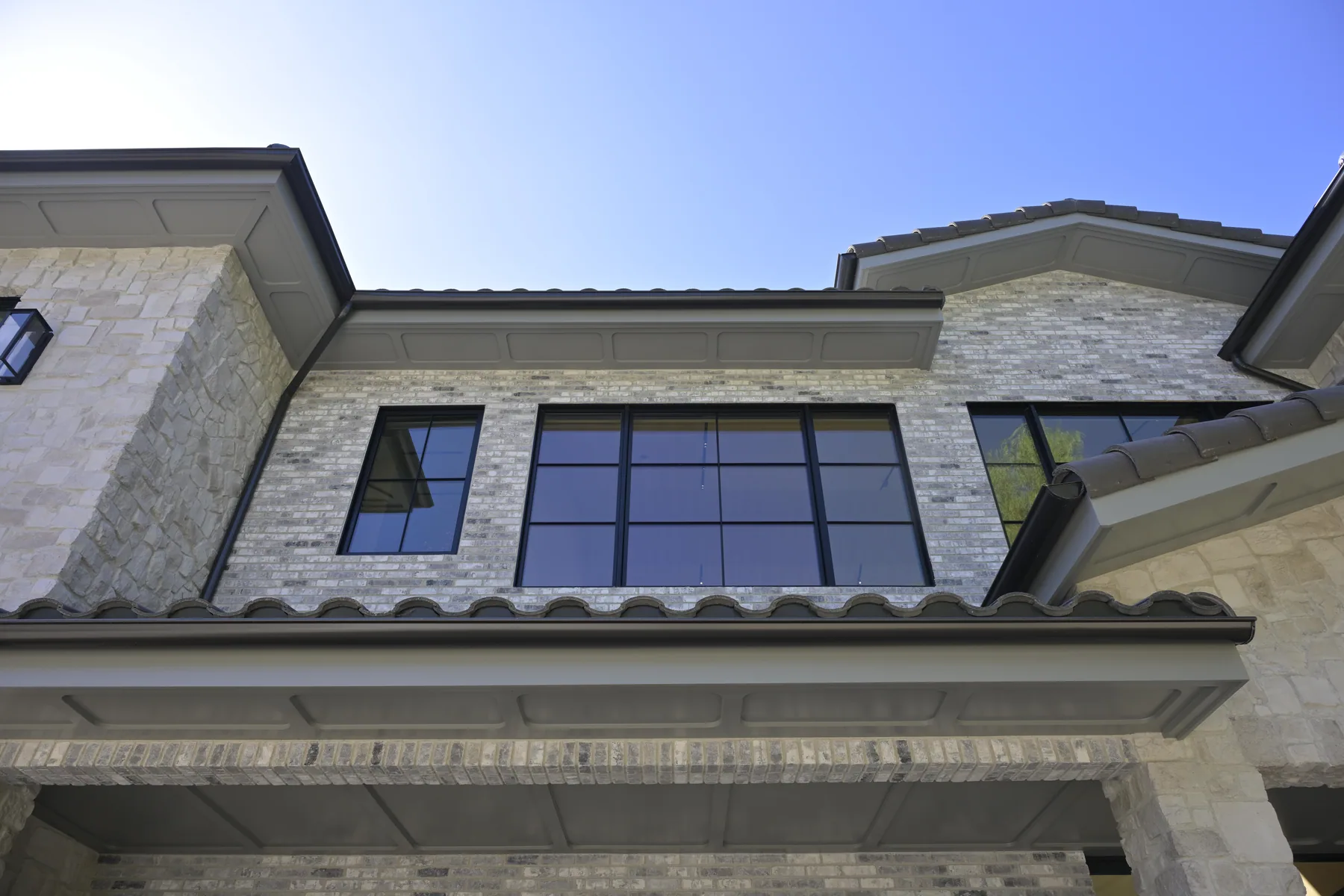

Profile and texture do more than color
- Three-tab shingles read flat and dated and are largely a budget decision.
- Architectural or dimensional shingles have depth and shadow, and they are the default for good reason.
- Concrete or clay tile gives strong shadow lines and real longevity, and it weighs enough that the structure has to be checked before switching to it.
- Standing seam metal reads modern, lasts a very long time, and is unforgiving of a complicated roof geometry.
- Flat and low-slope roofs are a membrane decision rather than a material one, and detailing at the edges matters more than the field.
The details that make a roof look finished
The field of the roof is the least interesting part. What reads from the street is the edge — fascia, the drip line, the way the roof turns a corner, the ridge, and the flashing at every wall and chimney. Upgrading the ridge detail or the fascia while the roof is off costs little relative to the whole job and does more visually than a color change.
Gutters are part of the design whether or not you treat them that way. Their color either disappears into the fascia or draws a line across the house. Choose deliberately.
Want a real number for your project?
The site visit and the itemized written estimate are free.
What to deal with while the roof is off
This is the argument worth making at the start: the expensive part of roof work is access and tear-off, and both are already paid for. While the deck is exposed, this is the cheapest moment in the building’s life to add or upgrade attic insulation, improve attic ventilation, replace or add skylights or solar tubes, run conduit for future solar, and repair any deck damage properly rather than covering it.
Every one of those is disproportionately expensive as a separate job later.
Skylights, and the honest version
A skylight or a solar tube transforms a dark hallway, bathroom or kitchen more than any electric lighting can. They are also a penetration through the weatherproof layer, and every leak risk on a roof is at a penetration. Installed properly during a re-roof, with the right flashing kit, they are reliable. Added later, into an existing roof, they are the most common source of a new leak.
What costs more than people expect
- Switching to tile from shingle. The weight may require structural work.
- Complex roof geometry. Valleys, dormers and penetrations are where the labor goes.
- Deck repair discovered at tear-off. Unknown until the old roof comes off.
- Fire-zone requirements. Class A roofing is required in Very High Fire Hazard Severity Zones.
What is cheaper than people expect
- Attic insulation and ventilation upgrades while the deck is open.
- Skylights installed during the re-roof rather than afterwards.
- Better ridge and fascia detailing.
- Conduit for future solar, run now.
Decisions you cannot undo
The material and color, for twenty years or more. Anything structural required by a heavier material. Penetrations. And every opportunity that existed while the deck was open.
Questions we get asked
How do I choose a roof color I will not regret?
Do not judge it from a sample in your hand. Look at real roofs in the neighborhood in that material, seen from the street at an angle in full sun. Then check it against the things you are not replacing — stucco, window frames, stone, driveway. If you plan to repaint later, choose the roof first and paint to it.
Can I switch from shingle to tile?
Sometimes, but tile is considerably heavier and the existing structure has to be checked before you commit. That assessment should happen before you choose the material, not after.
What should I do while the roof is off?
Attic insulation and ventilation, skylights or solar tubes, conduit for future solar, and any proper deck repair. Access and tear-off are the expensive parts and they are already paid for — every one of those is much more expensive as a separate job later.
Are skylights a leak risk?
Every penetration is. Installed during a re-roof with the correct flashing kit they are reliable; retrofitted into an existing roof they are the most common source of a new leak. If you want one, the time is when the roof is being replaced.
Does a lighter roof actually reduce cooling costs?
It reflects more heat, and the effect is most noticeable on a house with limited attic insulation. It is one factor among several rather than a transformation on its own.
Why is my quote higher than my neighbor’s for the same size roof?
Usually geometry. Valleys, dormers, chimneys and other penetrations are where roofing labor goes, so two roofs of identical area can differ substantially. Deck damage found at tear-off is the other common reason.
Related: All design ideas · Roofing · Roof replacement cost · Roof permits in Los Angeles · Roof replacement project
Tell us about your roof
Send us the basics — the age and material of the roof, any leaks you know about, and roughly when you would like to start — and we will come out, take measurements and put a written scope and estimate in front of you within about 48 hours of the visit.