
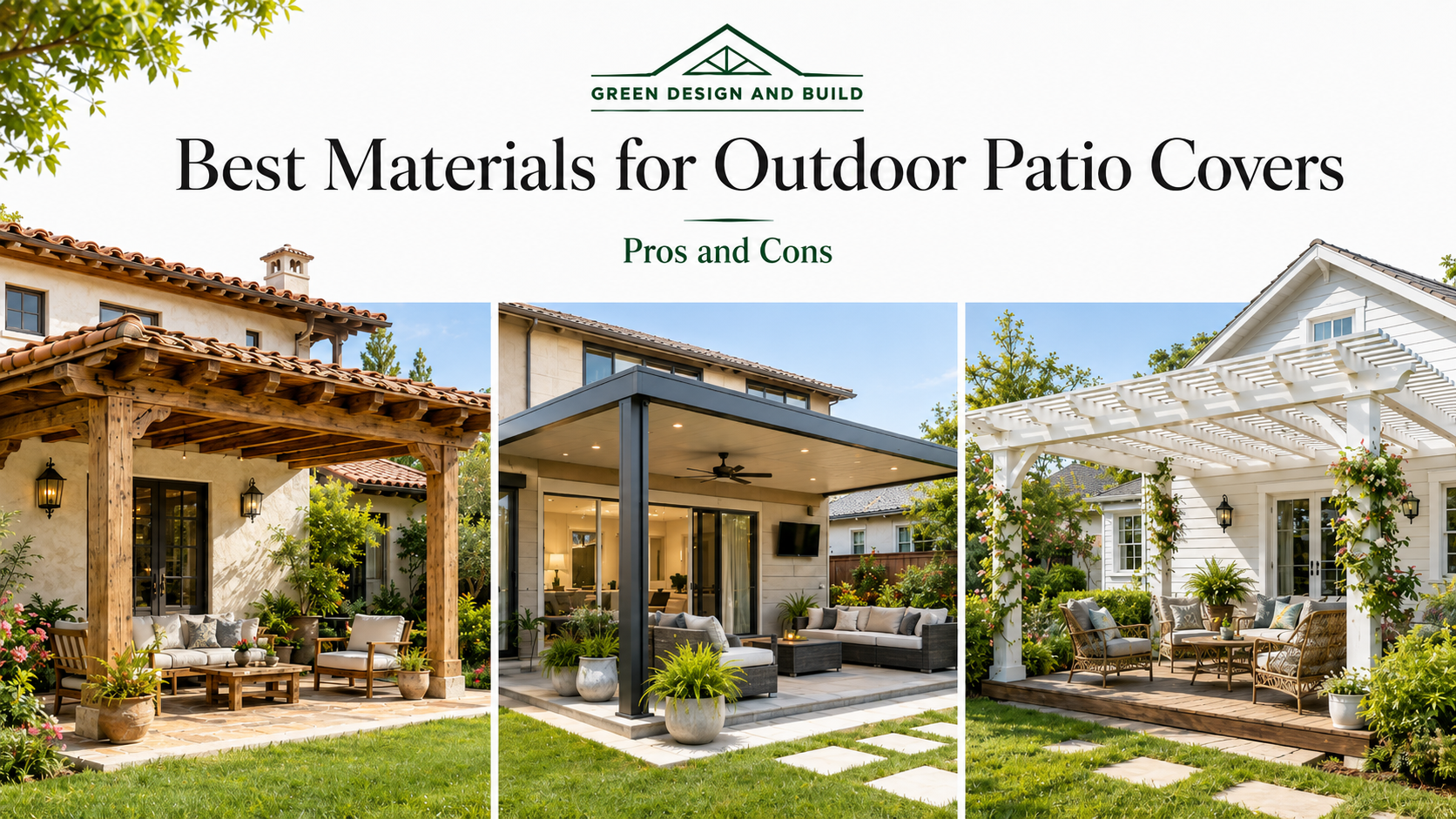
Choosing the best material for an outdoor patio cover is not as simple as asking which option looks the best or costs the least.
As a general contractor, the right patio cover material depends on how you actually plan to use your backyard, how much sun the property gets, whether you want full or partial shade, how much maintenance you are willing to deal with, and whether you want to add features like recessed lights, ceiling fans, a TV, heaters, or an outdoor kitchen.
There isn’t one perfect patio cover material for every home.
For most homeowners, we recommend Alumawood because it gives you a strong balance of appearance, durability, value, and low maintenance. For homeowners who want to create a true outdoor living space and are concerned about heat, we often recommend insulated aluminum panels. Real wood can be beautiful for someone who wants a natural, custom architectural look and understands the maintenance involved. Lattice works well when the goal is filtered shade and an open feeling. Steel can make sense for certain custom designs and larger structural spans.
The most important question isn’t simply, “What’s the best patio cover material?”
The better question is:
What’s the best patio cover material for the way you’re actually going to use the space?
Best Patio Cover Materials at a Glance
The most common outdoor patio cover materials and systems we discuss with homeowners include:
- Alumawood and other aluminum patio cover systems
- Insulated aluminum patio panels
- Real wood
- Lattice patio covers
- Steel
Each one has advantages and disadvantages. The right choice comes down to your property, lifestyle, expectations, and budget.
Alumawood Patio Covers: My Most Common Recommendation for Homeowners
The material we recommend most often is probably Alumawood, especially for homeowners here in Southern California.
The reason is pretty simple: you get the appearance of wood without a lot of the maintenance that comes with real wood.
With Alumawood, you don’t have to worry about termites, rotting, warping, or constantly repainting and restaining it the way you might with natural wood. It holds up well in sunny conditions, and for many homeowners, it simply makes sense because they want something that looks good without becoming another item on their annual maintenance list.
For most residential projects, Alumawood offers a good balance between cost, appearance, durability, and maintenance.
Pros of Alumawood Patio Covers
Some of the biggest advantages include:
- Low maintenance compared with real wood
- No concern about termites damaging the aluminum itself
- No rotting
- No regular staining required
- Available in finishes designed to create a wood-like appearance
- Good overall value for many residential backyards
- Can provide full shade when used as a solid patio cover
- Can often be designed to accommodate lighting, fans, and other features when planned correctly
Cons of Alumawood Patio Covers
The biggest disadvantage is that it is not real wood.
Some homeowners can immediately see or feel the difference, especially if they have a highly custom, traditional, or architectural home where authentic natural materials are important to the overall design.
For someone who loves the warmth, texture, and character of real wood, an aluminum system may not create exactly the same feeling.
But for a homeowner who tells me, “I want something practical, clean-looking, durable, and relatively low maintenance,” Alumawood is usually a very strong option.
Real Wood Patio Covers: Beautiful, Custom, but Higher Maintenance
Real wood is probably one of the most beautiful patio cover materials when it’s designed and built correctly. You can customize it, paint it, stain it, use larger beams, and make the structure feel like a true extension of the home’s architecture.
For certain properties, especially higher-end or custom homes, wood can look incredible.
The tradeoff: maintenance.
Wood is a natural material. Over time, it can move, crack, fade, and weather. Sun exposure can affect the finish. Moisture can cause damage. Termites may become a concern. Depending on the property and exposure, the cover may eventually need to be repainted, restained, sealed, or repaired.
There is nothing wrong with choosing wood in the right situation.
Choose wood because when you understand what comes with it and still love it, not because they saw one beautiful picture online and nobody explained what the material might require five, ten, or fifteen years later.
Pros of Real Wood Patio Covers
Real wood can offer:
- A warm, natural appearance
- Greater customization possibilities
- The ability to paint or stain the material
- A high-end architectural look
- Larger or more decorative beams depending on the design and engineering
- A traditional appearance that may better complement certain homes
Cons of Real Wood Patio Covers
Homeowners should also understand the potential downsides:
- More maintenance than aluminum
- Repainting or restaining may be necessary over time
- Possible sun damage and fading
- Possible cracking or movement as the material ages
- Moisture concerns
- Potential termite damage
- Higher long-term maintenance costs
We probably would not recommend it to someone who tells us, “I don’t want to think about this again for the next 15 years.”
Insulated Patio Covers: Best for Comfort and Outdoor Living Spaces
Insulated patio panels are another option we really like, especially when a homeowner actually plans to spend a lot of time underneath the patio cover.
If you are trying to create more of an outdoor room than just a shaded area, insulated panels can make a lot of sense.
Maybe you want:
- Recessed lights
- A ceiling fan
- A TV
- Comfortable outdoor furniture
- Speakers
- Heaters
- An outdoor kitchen
- A space for family dinners or entertaining
An insulated aluminum system can provide a clean, finished ceiling appearance while also helping reduce some of the heat radiating down from the roof compared with a basic single-skin metal roof.
This is especially important when a backyard gets heavy direct sunlight.
Pros of Insulated Patio Covers
Some of the biggest benefits include:
- Full shade
- Better comfort under heavy sun exposure compared with a basic single-skin aluminum roof
- A cleaner, more finished ceiling appearance
- Excellent potential for creating an outdoor living area
- Can work well with recessed lighting and ceiling fans when planned correctly
- Low maintenance compared with real wood
- Good rain protection when properly installed
Cons of Insulated Patio Covers
The biggest downside is usually the higher upfront cost.
For a homeowner who only wants basic shade over a small seating area, an insulated system may be more than they actually need.
But for someone who plans to use the space every day, especially in a backyard with strong afternoon sun, I think the additional value can absolutely make sense.
A Real Homeowner Example: Why the Best Material Isn’t Always the One You Originally Wanted
One project that stands out involved a homeowner who originally thought they wanted a wood patio cover because they loved the warm, natural appearance.
But once we started talking about how they actually used their backyard, it became clear that wood probably wasn’t the best fit for their lifestyle.
They had a busy household and spent a lot of time outside with their family. They wanted something they could enjoy without constantly worrying about maintenance.
One of their biggest concerns was heat because the backyard received a lot of direct sun, especially in the afternoon. They also wanted recessed lighting and a ceiling fan so the patio could feel more like an extension of the house.
Instead of simply agreeing with what they originally requested, we walked them through the differences between real wood, standard Alumawood, lattice, and insulated panels.
Wood would have looked beautiful, but they really didn’t want to deal with repainting, staining, possible termite issues, or repairs later.
Lattice wasn’t going to give them enough shade because they wanted to use the patio during the hottest parts of the day.
Standard Alumawood was definitely a good option, but because heat and comfort were such major concerns, We recommended an insulated aluminum patio cover.
For their lifestyle, it simply made more sense.
They got:
- Full shade
- A clean, finished ceiling
- Space for recessed lights
- A ceiling fan
- Less maintenance than real wood
- A backyard area they could actually use more comfortably
Most importantly, they ended up with a space that worked for the way they lived instead of something that only looked nice in pictures.
That is something I always try to explain to homeowners. The best patio cover isn’t necessarily the one you originally had in mind or even the most expensive option.
It’s the one that fits how you actually live.
Lattice Patio Covers: Best for Partial Shade and an Open Feeling
Lattice is completely different from a solid patio cover because the goal is not complete protection from the sun or rain.
It is about filtered shade, appearance, airflow, and maintaining an open feeling.
Lattice is for homeowners who still want sunlight coming through and don’t want the backyard to feel dark or completely enclosed.
It can look beautiful over:
- Pool areas
- Gardens
- Walkways
- Outdoor seating areas
- Backyards where the homeowner wants partial rather than full shade
But expectations are important.
A lattice patio cover is not going to provide full rain protection, and it won’t block all the heat or sunlight.
If a homeowner tells us their number one concern is that the backyard becomes unbearably hot at 3:00 or 4:00 in the afternoon, lattice probably isn’t the first thing we are going to recommend.
Especially if the property receives heavy western afternoon sun.
Lattice is great when you want filtered shade.
It is not the right choice when you expect it to perform like a fully covered roof.
Pros of Lattice Patio Covers
- Allows some sunlight through
- Creates filtered shade
- Maintains an open and airy feeling
- Can complement gardens, pools, and sitting areas
- Good option for homeowners who don’t want full shade
Cons of Lattice Patio Covers
- Does not provide complete rain protection
- Does not block all sunlight
- May not provide enough comfort in areas with intense afternoon sun
- Is not ideal when maximum shade is the main goal
Steel Patio Covers: Strong but Not Necessary for Every Backyard
Steel is probably the option we recommend least often for a typical residential patio cover.
That doesn’t mean steel is bad. Steel is extremely strong and can be an excellent choice for certain projects.
It can make sense for:
- Larger structural spans
- Custom architectural designs
- Certain modern homes
- Projects where engineering or design requirements call for greater structural capacity
But most homeowners don’t actually need steel for a standard residential backyard.
It can be more expensive, heavier, and more complicated to work with. It also needs to be properly protected against rust and corrosion.
For a typical residential patio cover, we usually would not tell someone they need steel unless there is a structural or specific design reason for it.
The Biggest Mistake Homeowners Make: Choosing Based Only on Price or Appearance
One of the biggest mistakes we see is homeowners choosing a patio cover based only on the upfront cost or how it looks in a picture.
A patio cover can look beautiful on day one.
The question is how it will perform five, ten, or fifteen years later.
Some homeowners choose the cheapest option because they are trying to save money, which I completely understand. But sometimes they end up with a cover that doesn’t provide enough shade, gets extremely hot underneath, or doesn’t fit the way they actually use their backyard.
Later, they may start trying to add:
- Ceiling fans
- Extra shade
- Electrical features
- Different panels
- Additional modifications
At that point, they may end up spending more than they would have if they had chosen the right system from the beginning.
The cheapest proposal is not always the cheapest project in the long run.
Don’t Ignore the Direction of the Sun
Another major mistake is failing to consider where the sun actually hits the property.
I’ve seen homeowners focus so much on the patio material and design that they don’t think about what happens at 3:00 or 4:00 in the afternoon.
You can install a beautiful lattice patio cover, but if your main goal is to sit outside comfortably in the late afternoon and your backyard gets heavy direct western sun, you may quickly realize that you’re still receiving much more heat and sunlight than expected.
The opposite can happen with a solid cover.
A homeowner may want maximum shade without thinking about how the new structure could affect the natural light coming into the house.
You have to look at the entire property.
Ask:
- Which direction does the house face?
- Where does the strongest afternoon sun come from?
- Where are the windows and doors?
- How much natural light do you want to preserve?
- What time of day will you actually use the patio?
- Are you trying to create full shade or filtered shade?
Those answers may completely change my recommendation.
Think About How You Will Actually Use the Patio
Before choosing a material, I always want to understand how the homeowner plans to live in the space.
Are you entertaining guests?
Do you have kids?
Will you have family dinners outside?
Do you want a TV?
Do you need recessed lighting?
Will you install ceiling fans or heaters?
Do you want to sit outside during the hottest part of the afternoon?
Do you want protection from rain?
How much maintenance are you realistically willing to do?
Those answers usually tell me much more about what material I should recommend than simply asking, “Which one looks the best?”
Rain Protection Depends on More Than the Material
A solid Alumawood cover, insulated panel system, or properly built wood patio cover can all provide good rain protection.
Lattice obviously will not provide the same protection.
But even with a solid patio cover, the installation matters just as much as the material.
You need proper:
- Flashing
- Waterproofing
- Drainage
- Gutters where appropriate
- Attachment to the house
A great material installed poorly can still leak.
That is why we don’t think homeowners should only ask what material is being installed. They should also ask how the contractor plans to attach it, waterproof it, and manage rainwater.
Planning for Lights, Fans, TVs, and Other Features
A lot of patio cover systems can accommodate electrical features, but they should be planned before construction whenever possible.
We always want to know upfront whether the homeowner wants:
- Recessed lights
- A ceiling fan
- A TV
- Heaters
- Speakers
- Electrical outlets
- An outdoor kitchen
These decisions can affect the structure, electrical planning, blocking, circuits, and the type of patio cover we recommend.
A homeowner may say, “I’ll just add a ceiling fan later.”
But if the proper support or electrical preparation wasn’t installed during construction, adding that fan later may become more complicated and expensive.
Even when you’re not installing every feature immediately, it’s smart to discuss future plans before the patio cover is built.
What to Ask Before Choosing a Patio Cover Contractor
Before making a final decision, homeowners need to look beyond the total price and the picture of what the finished patio is supposed to look like.
One of the biggest mistakes we see is comparing two estimates and assuming they include the same thing.
They may not.
Two estimates can involve completely different:
- Materials
- Product specifications
- Structural systems
- Installation methods
- Warranties
- Electrical work
- Drainage systems
- Permit responsibilities
Two patio covers can look almost identical in a photograph and be completely different in terms of quality and installation.
Ask Exactly What Product Is Being Installed
Don’t just ask, “Is it Alumawood?”
Ask:
- Who is the manufacturer?
- What is the product line?
- What type of roof panel is being used?
- What thickness or gauge applies?
- What finish are you getting?
- What color are you getting?
- What warranty applies?
The contractor should be able to explain exactly what you’re paying for.
Ask How the Patio Cover Will Attach to the House
This is a very important question homeowners often don’t think about until there’s a leak or another problem.
Ask:
- Is it attached to the fascia?
- Is it attached directly to the wall?
- Will there be a ledger?
- How is it being flashed?
- How will water be prevented from getting behind the attachment point?
This is one of the biggest differences between a quality installation and a cheap one.
You can use an excellent material, but if the attachment and waterproofing are handled poorly, you can still have problems.
Ask Where the Rainwater Will Go
Ask one simple question:
Where is the rainwater actually going to go?
Does the patio cover include gutters?
Where will the downspouts terminate?
Will the water dump next to the foundation?
Will it drain toward a walkway?
Could it create standing water?
Could it affect the neighboring property?
A lot of people think about shade but don’t think about water until the first heavy rain.
Ask About Permits Before Signing
Permit requirements can depend on factors such as the city, size of the patio cover, attachment method, height, electrical work, and other project details.
Before signing, get clear answers to questions like:
- Is a permit required?
- Who is responsible for pulling it?
- Are permit fees included in the proposal?
- Are plans required?
- Is engineering required?
- Are inspections included?
Get these details in writing.
The last thing you want is to be halfway through construction and suddenly discover an additional permit, engineering, plan, or city fee that nobody explained before the project started.
Ask Exactly What “Electrical Included” Means
Electrical work is another area where homeowners sometimes assume more is included than actually is.
If you want lights, fans, outlets, heaters, speakers, or a TV, ask exactly what the proposal includes.
For example:
- How many lights?
- What type of lights?
- Are switches included?
- Is the wiring included?
- Is a new electrical circuit required?
- Can the existing panel handle the additional load?
- Is patching included if walls need to be opened?
- Is painting included afterward?
Don’t simply accept the words “electrical included.”
Make sure you know what that actually means.
Ask About Posts, Beams, and Footings
Homeowners should also understand how the patio cover will be structurally supported.
Ask:
- How many posts will there be?
- Where will they be located?
- What size beams will be used?
- Are new concrete footings required?
- Will posts attach to existing concrete?
- Is the existing slab adequate?
A lot of homeowners understandably want fewer posts because they want a cleaner, more open view.
But you cannot simply remove posts without considering the span, beam size, structural requirements, and engineering.
The design has to work structurally, not just visually.
Ask What Happens to Existing Stucco, Concrete, Roofing, and Landscaping
Another important question is what happens where the new patio cover meets the existing property.
Will anything need to be cut or disturbed?
Ask whether the project may affect:
- Stucco
- Roofing
- Fascia
- Concrete
- Pavers
- Landscaping
- Paint
Then ask who is responsible for restoring those areas.
Will stucco patching be included?
Will painting be included?
If concrete or pavers need to be disturbed, who puts everything back?
These smaller details are often exactly where change orders and misunderstandings happen later.
Understand the Difference Between a Material Warranty and a Workmanship Warranty
Ask about warranties, but don’t stop at asking, “Is there a warranty?”
Ask what the manufacturer covers and what the contractor covers, because those are two different things.
A manufacturer may provide coverage for the material itself, but that doesn’t necessarily mean the warranty covers:
- Improper installation
- Flashing problems
- Leaks caused by workmanship
- Electrical issues
- Labor
Ask:
- How long is the material warranty?
- How long is the workmanship warranty?
- What exactly is covered?
- What is excluded?
- Who do I call if there’s a problem?
Those details matter.
Red Flags to Watch Out for When Hiring a Patio Cover Contractor
One of my biggest red flags is when a contractor becomes uncomfortable because a homeowner asks detailed questions.
A good contractor should be able to explain the material, installation method, drainage, permits, electrical work, and warranty in a way that makes sense.
They shouldn’t make you feel like you’re being difficult just because you’re asking what you’re paying for.
Another major red flag is a vague proposal.
If an estimate simply says:
“Install a 300-square-foot patio cover.”
That’s not enough.
The proposal needs to identify details such as:
- Approximate dimensions
- Type of patio cover
- Material
- Manufacturer or product where applicable
- Solid versus lattice design
- Number and approximate location of posts
- Selected color, if known
- Electrical features
- Drainage components
- Demolition, if applicable
- Permit responsibility
- Major exclusions
The more vague the scope is, the easier it becomes for the homeowner and contractor to have completely different expectations.
The One Question Every Homeowner Should Ask Before Signing
Before you sign a contract, ask the contractor one simple question:
“What exactly am I getting from start to finish, and what could possibly cost me extra?”
Ask about:
- Permits
- Engineering
- Electrical upgrades
- Hidden damage
- Rotten fascia
- Concrete footings
- Stucco repair
- Painting
- Moving drains
- Existing structural conditions
- Anything else that may not be visible until work begins
A contractor can’t always predict every hidden condition.
But they should be honest about the possibilities.
Which Patio Cover Material Offers the Best Overall Value?
Tthe best overall value for most homeowners is usually Alumawood or an insulated aluminum system, depending on the budget and how much the space will actually be used.
If you want low maintenance and good overall value, Alumawood is hard to beat.
If you want maximum comfort and are trying to create a true outdoor room, I would lean toward insulated panels.
If you want a natural, custom architectural look and don’t mind the maintenance, real wood can be beautiful.
If you want partial shade with a more open feeling, lattice may make sense.
If the project is highly custom, requires larger spans, or has specific modern structural requirements, steel may be worth considering.
There isn’t one right answer for everyone.
Final Thoughts: Choose the Material for Your Lifestyle, Not Just the Picture
Stop thinking only about what looks good today and start thinking about how you want to live in the space for years to come.
Are you going to have family dinners outside?
Do you have kids?
Do you entertain?
Does the backyard get heavy afternoon sun?
Do you want a TV, lights, and ceiling fans?
Do you want protection from rain?
How much maintenance are you really willing to do?
Once you answer those questions, the right patio cover material usually becomes much clearer.
And don’t choose a contractor based only on who can start the fastest or who gives you the lowest number.
Look at whether the contractor is properly licensed for the work being performed, whether appropriate insurance is in place, whether the contract clearly explains the scope, whether the materials are specifically identified, and whether the contractor takes the time to understand how you’re actually going to use the space.
Because a quality patio cover isn’t just about putting a roof over your backyard.
It’s about making sure the structure is sound, properly waterproofed, drains correctly, complements the house, supports the features you want, and continues to perform the way it should in the years ahead.
The goal shouldn’t just be to build a patio cover.
The goal should be to create a space you’re actually going to enjoy and use without looking back later and saying, “I wish someone had explained this to me before I chose it.”